| Tools: Save | Print | E-mail | Most Read |
| Competitive Sports |
| Adjust font size: |
Widely seen as a rehearsal for the 2008 Olympics, China's Tenth National Games was held in October 2005, in Nanjing, the last comprehensive national sports gathering before the Beijing Olympics. Fifteen athletes broke six world records for 21 times, 7 athletes equaled six world records for 7 times, and 5 athletes registered five new Asian records for 6 times. Back in March 1959, at the 25th World Table Tennis Championships held in Germany, the table-tennis player Rong Guotuan won the first world title in China's sporting history. It was followed by many more successes. By the end of 2005 Chinese athletes had altogether won 1,906 world championships and broken world records 1,140 times. In the 17 years since 1989, Chinese athletes have won 1,552 world championships, accounting for 81.4 percent of the total; and broken world records 758 times, making up 66.5 percent of the total. It was a period when China's competitive sports enjoyed continuous and rapid development. At the 2004 Olympics, China took home 63 medals, 36 of them (57.1 percent of the total) being won by young athletes; 10 of the gold medal winners were under 20 years old, which demonstrates the increasing maturity of China's young athletes and growing overall strength in competitive sports.
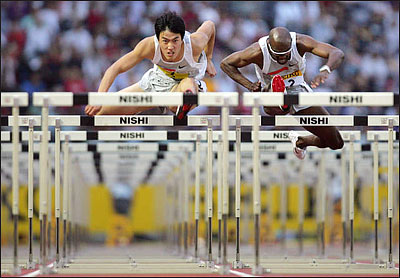
At the 2004 Olympics, Chinese athletes excelled in canoeing, tennis, and track and field. Liu Xiang made Chinese sporting history by taking gold in the 110-meter hurdles equaling the world record time of 12.91 seconds and registering a new Olympic record. In canoeing Meng Guanliang and Yang Wenjun won the men's C2500 final, China's first Olympic gold in aquatic sports. Sun Tiantian and Liu Ting won the women's tennis doubles final, China's first ever tennis gold. The credit for China's achievements in competitive sports should go to the training system, which is constantly being perfected. It is based on juvenile amateur sports schools and basic-level clubs, with teams representing localities as the backbone, and the national team at the highest level. The training system ensures that China's elite teams maintain a year-round squad of some 20,000 outstanding athletes, to become a crack force capable of scaling international sporting heights. On February 3, 2004, the State Council proclaimed the Anti-Doping Regulations, stipulating in detail for the first time regulations concerning doping control, anti-doping obligations, doping examination and monitoring, and legal liabilities. The Regulations came into force on March 1, 2004. |
| Tools: Save | Print | E-mail | Most Read |
 |
| Related Stories |
