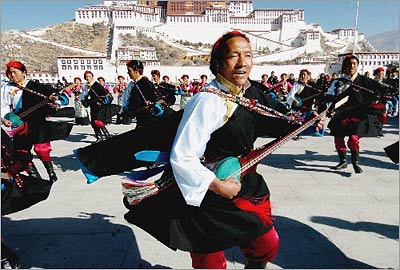
Equality, unity, mutual help and common prosperity are the basic principles of the Chinese government in handling the relations between ethnic groups. In accordance with these basic principles, China practices a regional ethnic autonomy system. Where ethnic minorities live in compact communities, autonomous organs of self-government are established under the unified leadership of the state. The minority people exercise autonomous rights, are masters in their own areas and administer their own internal affairs. Besides, the state makes great efforts to train ethnic minority cadres and professional technicians in institutions of higher learning, and universities, colleges and cadre schools for ethnic minorities. The Central Government also actively aids the ethnic autonomous areas with funds and materials so as to promote the development of the local economies and cultures. The Law on Regional Ethnic Autonomy adopted in 1984 at the Second Session of the Sixth NPC is the basic law specifically guaranteeing that the constitutionally decreed regional ethnic autonomy system is carried out. Today, in addition to the five autonomous regions (Inner Mongolia, Xinjiang Uygur, Guangxi Zhuang, Ningxia Hui, and Tibet autonomous regions), China has 30 autonomous prefectures and 120 autonomous counties (known, in some cases, as "banners"), as well as over 1,100 ethnic townships. The organs of self-government in ethnic autonomous areas are the people's congresses and people's governments of autonomous regions, autonomous prefectures and autonomous counties (banners). The chairperson or vice-chairpersons of the standing committee of the people's congress and the head of an autonomous region, autonomous prefecture or autonomous county (banner) shall be citizens of the ethnic group exercising regional autonomy in the area concerned.
 |
Organs of self-government in ethnic autonomous areas enjoy extensive self-government rights beyond those held by other state organs at the same level. These include: enacting regulations on the exercise of autonomy and separate regulations corresponding to the political, economic and cultural characteristics of the ethnic group(s) in the areas concerned; having the freedom to manage and use all revenues accruing to the ethnic autonomous areas; independently arranging and managing local economic development, education, science, culture, public health and physical culture, protecting and sorting out the cultural heritage of the ethnic groups, and developing and invigorating their cultures.