|
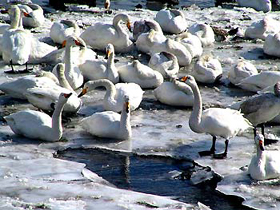
Hundreds of swans in Chengshanwei Town in east China's Shandong Province are in danger this year, jeopardized by a lack of fresh water.
"Since last week several swans have died of thirst, and the number is increasing as the weather gets ice-cold," said Yuan Xueshun, director of Weihai Swan Protection Association.
For the past 30 years, Yuan has been a full-time swan watcher. He lives only a kilometer away from the swan lake.
"Swans live in this place. They have been standing here and waiting for fresh water for several days. They just won't leave their home," Yuan said.
Construction projects near the Rongcheng Swan Lake in the past four years are blamed for the lack of water, said the local Qilu Evening Newspaper.
Rongcheng's forestry department said yesterday they are making efforts to introduce fresh water to save the swans.
The renowned Rongcheng Swan Lake is surrounded by pine trees and reeds. It contains a variety of small creatures and seaweed that swans eat.
In November, swans come to the lake for winter from China's Xinjiang Uygur Autonomous Region and Russia's Siberia.
In 1992, the number of swans in the lake was more than 6,000. The number was down to 400 last year and 600 this time around.
Nearby the swan lake, 70 hectares of natural wetland made of sand and mud ensured a reserve of freshwater for swans. Those wetlands are also a rich source of algae and seashells.
Swans drink freshwater and eat the algae and seashells.
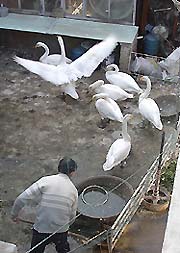
Yuan Xueshun, a fulltime swan watcher now raises several injured swan home.
Over the past several years, a series of "swan lake comprehensive development" projects have destroyed the natural environment, the local paper said.
Silt at the bottom of the lake was dug out, making it very difficult for swans to search for food.
The black silt pulled from the lake was piled up at random above the nearby wetland, that swans have lived on in the past.
In the past four years the silt has piled up to more than 2 meters thick.
(China Daily November 26, 2004)
|