Daodejing
Classic text of Chinese philosophy. Written between the 6th and 3rd centuries BC, it was originally named Laozi after its traditional author but the mystery of its true authorship so far remains unresolved. The Daodejing promotes a way of life intended to bring harmony and tranquility to a troubled kingdom. It encourages passivity, interpreted as foregoing any unnatural action which would impair the Tao from resolving things naturally. It was used as a handbook by rulers who were encouraged to impose no restrictions or prohibitions on their subjects. The Daodejing's influence has permeated to this day, affecting all schools of Chinese philosophy and religion that it preceded.
 |
Zhuangzi
The book of Zhuangzi named after its author is also known as Nan hua zhen jing (True Classic of Southern (Cultural) Florescence) since Emperor Xuanzong of the Tang Dynasty conferred this honorific title upon it in 742 AD to reference Zhuangzi's southern Chinese origins. The book is a composite of different writings and tradition indicates that Zhuangzi penned the first seven chapters (the "inner chapters") and that his disciples and related thinkers added the others (the "outer" and "miscellaneous" chapters).
 |
Liezi
The Liezi tome first surfaces during the former Han Dynasty, with editor Liu Xiang commenting that he rearranged Liezi into eight chapters. A surviving bibliography from the time notes that since Zhuangzi quotes Liezi. From this, it can be assumed that the latter predated the former. Following this, a three-century gap exists before Liezi is again mentioned in a commentary by Zhang Zhan during the Jin Dynasty, where Zhang claims his copy of Liezi came to him from his grandfather. All subsequent copies of the Liezi volume were based on Zhang's. Liezi was elevated to the rank of Taoist classic, during the reign of Emperor Xuanzong of Tang, rounding out the trilogy formed with the Daodejing and Zhuangzi. The Liezi was then honorifically entitled the Chong Xu Zhen Jing. It is widely considered the major Taoist work with the most thorough practical mindset, as opposed to the philosophical writings of The Daodejing and the poetic narrative of Zhuangzi.
 |
Daozang
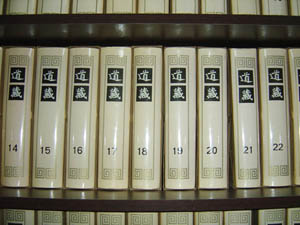
Daozang, or Taoist Canon, is a compendium of close to 5,000 individual texts dating back to in 400 AD, dating after core texts such as the Daodejing and Zhuangzi. Taoist monks of the era united them into one tome to facilitate the teachings of Taoism, while collating all the commentaries and expositions written by masters of Daodejing and Zhuangzi teachings. The Daozang is sub-divided into the Three Grottoes, mirroring the Buddhist Tripitaka. These three divisions were inspired by principal Taoist focus in southern China namely; meditation, ritual, and exorcism.
(China.org.cn April 20, 2007)