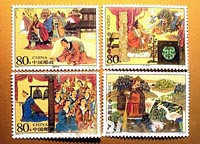
China's State Post Bureau (SPB) issued a set of stamps on the theme of traditional Chinese idioms recently, the first of its kind ever published by the SPB.
Traditional Chinese idioms are unique language expressions for a long period of time. As an important part of modern Chinese, they are usually composed of four characters and allude to certain allegoric or historical stories with profound philosophical meanings or life experiences.
To celebrate the first publication of one stamp of this set, a ceremony was held recently by the local post office in Yexian County, central China's Henan Province, home town of the hero of the idiom story on the stamp.
The story is about a nobleman surnamed Ye of the Spring and Autumn Period (770 BC-476 BC) who boasts about loving dragons but when the real dragon appears before him, he is thunder struck and scared away.
"Like this stamp, the story of which satirizes people boasting loving something but not really love at all, the other three of this set are all allegorical stories," said Zhao Yuhua, deputy director of the postage and stamp administration department of the SPB, who was invited to attend the ceremony.
The second story of the stamps in the set is about a man of the State of Yan of the Warring States Period (475 BC- 221 BC) who came to Handan, capital of the State of Zhao and tried to learn the walking by Handan people. In the end, he failed to learn the walking style, but almost forgot the walk of his own.
The third story is about a man named Nanguo in the Warring States Period. As the Qixuan King of the State of Qi liked listening to the music of yu, an ancient musical instrument, Mr. Nanguo, who didn't know how to play yu at all, but managed to join the orchestra of 300 yu players, pretending to play the yu very well to make up the number.
The fourth one is a parable that when the snipe and the clam grapple, it's the fisherman who stands by to be the beneficiary.
According to Zhao, the next set of this idiom series of stamps, also composed of four, will be issued next year.
"To issue stamps on traditional Chinese idiom is an attempt made by the SPB to widen their stamp theme selection and to promote the communication of Chinese stamp culture with the world," said Zhao.
(Xinhua News Agency April 13, 2004)