Mummies, brocades, figurines and earthenware are directing Beijingers along the ancient Silk Road.
Relics unearthed on part of the Silk Road in northwest China's Xinjiang Uygur Autonomous Region are on show in the capital at the Museum of Chinese History.
The three-month exhibition, which started last Wednesday, details lifestyles and progress from 2800 BC to the 10th century in the Taklimakan Desert and the Turpan Basin, at the foot of the Tianshan Mountains.
"Xinjiang was the hardest part of the Silk Road which prospered for about 1,000 years before the 9th century," said Du Gencheng, curator of the Xinjiang Uygur Autonomous Region Museum.
"It featured a multi-ethnic culture where the East met the West."
At the entrance of the exhibition hall stands a 2-meter-tall stone sculpture of a Turk Warrior. Warriors of this kind, which can be traced to the Tang Dynasty (AD 618-907), are seen on tombs of the Turks on the grassland.
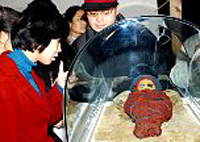
Also included in the exhibition are three mummies from the Taklimakan Desert.
The mummy of a new born baby, about 40 centimeters long, had two stone chips covering his eyes. The baby's delicate skin has been well-preserved in the 2,800 years following its death.
Gold and silver artifacts from Ili Kazak Autonomous Prefecture, Xinjiang, are among the most precious parts of the exhibition.
The shining gold masks, jars, sword sheaths and rings, decorated with rubies, can be traced to the Southern and Northern Dynasties (AD 420-581).
The 145 relics on display are a collection of the major archaeological finds since 1949, said Du.
(China Daily January 21, 2003)