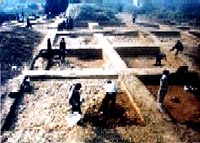
Chinese archeologists have brought to light ruins of an ancient city dating back 5,500 years, the earliest ever found in China's prolonged, agricultural-dominant history.
After several rounds of excavations, archeologists are able to confirm that the Lingjiatan relic site in east China's Anhui Province was once a bustling city with booming art handicrafts, textile and processing industries.
The site had been lying beneath an expanse of rice paddies and vegetable plots in the Chaohu Lake drainage area between the Yangtze and Huaihe rivers, until it was discovered in 1987.
From the 1.6 million-square-meter site, experts have unearthed a residential area with intricately designed houses, a 3,000-square-meter square paved with red pottery pieces and a graveyard with an altar and 66 graves.
"The square must have been a political, military and cultural center of the city, where local residents used to gather for meetings and perform religious rituals, and soldiers for drills," said Zhang Jingguo, a noted archeologist with the Anhui Provincial Institute of Archeology, who has headed the excavation.
Zhang and his colleagues have also unearthed a well, a moat, a stoneware workshop, three mammoth stone structures and more than 1,300 sacrificial pieces: pottery, stoneware, jade figurines and jade turtles imprinted with augury patterns.
Fixed abodes, large-scale temples, defense works and workshops are key evident factors to determine whether an origin of a civilization makes a city, according to Prof. Dong Jianhong, an established specialist in urban history from the prestigious Shanghai-based Tongji University.
Experts say the discovery of the prehistoric city has predated the origin of Chinese cities by over 1,000 years and could also extend China's recorded history to 8,000 or even 10,000 years, from what was previously known to be around 5,000 years.
Prior to the discovery, it was widely accepted that China's earliest city was formed some 4,000 years ago in today's Dantu Village, Wulian County of Rizhao City, in east China's Shandong Province.
Jade pieces unearthed from the site have aroused particular attention among archeologists.
"Those ancient city dwellers must have mastered advanced jade processing techniques," Zhang said after studying the texture of the jade pieces through a stereomicroscope.
Besides, all the jade figurines wear tartan hats and cross-stitched belts, a sign of a much advanced textile industry and proficient knitting skills.
"Obviously, those ancestors of the Chinese nation already wore threaded and hemp-made clothes rather than 'leaves and animal pelts' as some people used to claim," said Zhang.
Archeologists will go on with their excavation of the ruins this fall in an effort to solve more mysteries of the ancient city.
(Xinhua News Agency July 29, 2002)