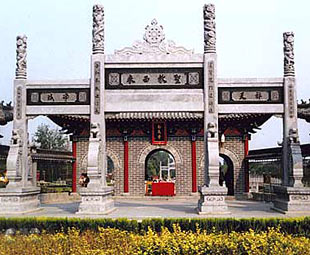
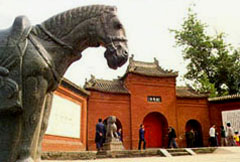
Abbot Shi Yinle has a lot of things to deal with every day as head of the White Horse Temple in Luoyang, China's first Buddhist temple.
But all that's on his mind at the moment is the expected completion in April of an Indian hall inside the 1,900-year-old temple.
The exotic structure, the same style as the Great Sanchi Stupa in India, is being financed by the Indian government as part of a religious and cultural exchange agreement endorsed by the prime ministers of the two neighbors in 2005.
Abbot Yinle is proud that his temple was chosen to house the Indian hall, almost 20 centuries after the introduction of Buddhism to China from India.
"Our temple stands as testimony to the time-honored friendship between China and India," he said.
The Indian hall covers 3,450 sq m and contains facilities for Buddhist lectures, prayers, exhibitions and conferences. All of the stone used to build the hall has been shipped from India.
A senior Indian engineer has been supervising the interior decoration, which started last September. Two other Indian master craftsmen will soon come to supervise the final exquisite wall carvings, said Hu Xuanyan, an official with Luoyang's religious affairs bureau.
A 3.6-m high Buddha statue from India weighing 22 tons was placed in the hall last September, the largest Buddha statue the Indian government has given to China, local officials said.
The White Horse Temple is named after an ancient tale about a white horse that carried Buddhist scripture between India and Luoyang, then China's capital city. The temple had its heyday during the rule of Wu Zetian (AD 624-705), the only woman emperor in Chinese history.
In exchange for the Indian hall, the Chinese government financed the building of a Xuanzang Memorial Hall in Nalanda, in the northern Indian state of Bihar in 2006. Xuanzang was a Buddhist monk, a translator and an envoy of peace and Buddhism between China and India some 1,300 years ago.
(China Daily January 12, 2008)