During the third general census of cultural relics in Hunan Province, an ancient road built during the Qin Dynasty (221–206 b.c.) was discovered around the environs of Dengjiatang Village, Chenzhou City in the province.
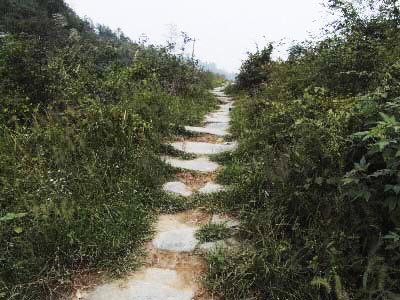
The Ancient Road of Mules and Horses
This roadway served as an important communications route two thousand years ago. "That ancient road is comparable to today's highway from Beijing to Zhuhai," Xie Wujing, an ancient road specialist in the Hunan Provincial Cultural Relics Bureau said.
"Hoof prints are still obvious on some of the slates. They couldn't have been formed in this way without hundreds of years of trampling," He Qiang, the deputy director of Cultural Relics Bureau of Hunan Province, said on October 11, 2007.
After thoroughly studying maps in the Chenzhou County Annals covering all the Chinese dynasties, Xie determined that the road was an ancient route that linked Hunan and Guangdong provinces, and was known as the Ancient Road of Mules and Horses.
The Chenzhou County Annals recorded that the Ancient Road of Mules and Horses was built during the 33rd year of the reign of the first Emperor of the Qin Dynasty (214 BC). Constructed with slate slabs measuring approximately 2 to 3 meters wide, this ancient highway was an important line of communications that linked the central plain area to southern China.
According to these records, the road was literally created when Yingzheng, the first Emperor of the Qin Dynasty, progressed toward south China during his war of unification. Leading an army of 500,000 people, he advanced into the South Yue Kingdom with 150,000 soldiers marching forward. They trampled grass and forests, crushing the earth and forming a road that later was enhanced and covered with slate.
Another piece of information recorded in the Chenzhou County Annals indicates that during the reign of Guangwu, emperor of the Han Dynasty, approx. AD 25 -57, Wei Sa, the chief administrator of Guiyang County (today known as Chenzhou City) went to great pains to maintain the road and even built hotels and post offices along it.
Xie Wujing said that the road was continually used for about 2,000 years and didn't veer from its original course after Wei Sa's efforts.
The thickly dotted prints of mules and horses not only indicate the large quantities of travelers through the road but also the road's popularity despite its remoteness, He Qiang added.
Some villagers have confessed that outsiders have actually begun purchasing these ancient slates or digging them up secretly. Locals have excavated the slate for use in home construction projects.
He Qiang said that ancient roads in Hunan Province aren't especially scarce but this slate imprinted with numerous hoof prints of mules and horses is indeed a rarity. The slate bears direct evidence of the economy, politics and culture of ancient Chinese society. Because it is the oldest and best-protected road, it will be listed as a cultural heritage site and remain under provincial protection. Authorities plan to apply for national protection as well.
This slate route is actually the first ancient road under provincial protection. The provincial cultural relics bureau plans to select a well preserved section of the highway, set arches at each side to mark the boundary and also post a plaque for tourists and travelers that states: this is the Ancient Road of Mules and Horses.
The Ancient Road of Mules and Horses in Dengjiatang Village
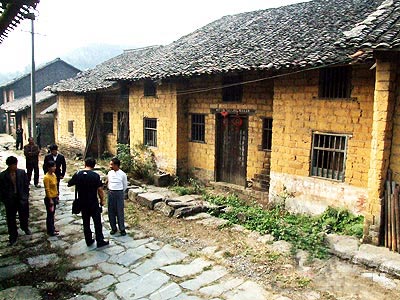
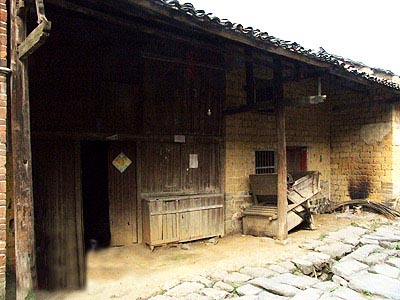
A farmer's house along the Ancient Road of Mules and Horses
A hoof print of mules and horses on a slate of the Ancient Road of Mules and Horses
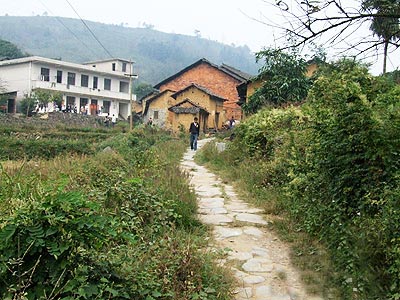
The Ancient Road of Mules and Horses
(China.org.cn by Chen Lin October 15, 2007)