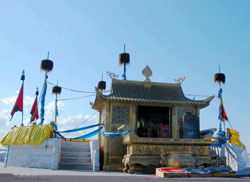
An elaborate ceremony was held on Monday at the mausoleum of Genghis Khan in north China's Inner Mongolia Autonomous Region to honour the Mongolian sacred emblem and weapon the Sulede.
The Sulede is a lethal-looking trident that was thought to have brought fortune and triumph to Genghis Khan's cavalry some 800 years ago.
According to the Mongolian legend, Genghis Khan acquired the Sulede after his troops suffered a defeat and were in very low morale.
Legend has it that an overlord asked for power and help from the God and suddenly a dazzling light flickered in the sky and the trident-like weapon floated over the heads of his army.
Genghis Khan demanded his general grab the weapon from the sky but failed after several attempts. After promising to worship the sacred weapon with the sacrifice of a 1,000 horses and 10,000 sheep the Sulede finally descended.
The ceremony started at 7:00 a.m. and was presided over by 90-year-old Garigdi, who is a 37th-generation member of the Dalhut tribe.
Every year the mausoleum holds three grand and more than 50 minor memorial ceremonies dedicated to the Sulede. The highest of these ceremonies is held on the 14th day of the seven month of the Chinese lunar calendar, said Nacugen, deputy director of the mausoleum administration.
He said Mongolians started worshiping the Sulede more than 700 years ago.
Genghis Khan was born in 1167 into an aristocratic family near the Onon River in Mongolia.
In 1206, he unified the Mongol tribes and became the Great Khan of the Mongol Empire. He was later conferred the title of "Genghis Khan", meaning "universal ruler".
Genghis Khan conquered most of Eurasia and fathered many children. Kublai, one of his grandsons, later became the first emperor of the Yuan Dynasty (1271-1368).
On July 11, Mongolia celebrated the 800th anniversary of Genghis Khan's march to world conquest.
(Xinhua News Agency August 8, 2006)