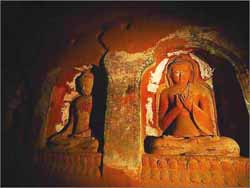
The Mogao Grottoes, a site on the World Heritage list, is being threatened by increasing arid conditions, say experts.
The intensified desertification caused by water shortages in the area has harmed the preservation of the cultural relics in recent years.
The grottoes are located on a cliff about 25 kilometers southeast of Dunhuang, a city in a desert in the southwest of Gansu Province in Northwest China.
More than half of the murals and painted sculptures in 492 caves are suffering from color changes or crisping and peeling, as well as other damage linked to an increasing number of sandstorms, said Wang Wanfu, deputy director of the Relics Preservation Research Institute under the Dunhuang Academy.
The water shortage in Dunhuang has mainly been caused by the increasing demand for supplies by residents and tourists, the relics protection expert told China Daily.
Formed since AD 366, the grottoes are made up of a 1,680-metre-long complex with 735 caves from different dynasties. Of the total, 492 in the south were for worshipping purposes and the remaining 243 in the north were used by monks to live in, Wang said.
Since 1987, when the grottoes were put on the World Heritage list by the United Nations Educational, Scientific and Cultural Organization, they have attracted more and more tourists from both home and abroad.
Local farmers have been pumping underground water for agricultural irrigation since the 1970s, and at present there are more than 1,500 such irrigation wells across Dunhuang, sources from the local water conservancy department said.
It has caused the level of underground water to drop by about 50 centimeters annually over the past 25 years, according to Ma Yucheng, deputy director of Dunhuang Municipal Water Authority.
The drop has also caused grassland degeneration and wetland withering, the official said.
The serious situation has drawn attention from local officials. Dunhuang municipal government has banned the drilling of new irrigation wells, and plans to develop a more efficient agriculture system to save water, according to Zhang Ping, Dunhuang's deputy mayor.
The local government has suggested creating a water diversion project for several years, which has been put aside because of fund shortages and arduous construction, Zhang said.
(China Daily February 27, 2006)