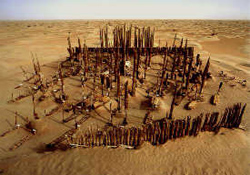
Archaeologists have finished the excavation of an ancient tomb complex in the Lop Nur Desert in the northwest of China, but researchers are baffled, saying they need more time to understand the finds.
Archaeologists in Xinjiang Uygur Autonomous Region have unearthed 163 tombs at the Xiaohe Tomb complex, which sprawls over a 2,500-square-metre oval-shaped dune, 174 kilometers from the ruins of the Loulan Kingdom, an ancient civilization that vanished 1,500 years ago.
The complex contains about 330 tombs, but about 160 of them were spoiled by grave robbers, said Idelisi Abuduresule, head of the Xinjiang Cultural Relics and Archaeology Research Institute, which launched the excavation project in October 2003 with the approval of the State Administration of Cultural Heritage.
Archaeologists found boat-shaped coffins in the tombs, including one just 55 centimeters long, designed for an infant's body.
"Most objects found in the tombs remain untouched, and will help us learn about the local social culture and customs at that time," Idelisi said.
The massive burial site was first discovered in 1934 by Swedish explorer Folke Bergman. His archaeological diary helped Chinese researchers locate the site at the end of 2000, after the diary was published in Chinese.
With the excavation complete, the researchers returned to the regional capital to chew over what they have found.
The researchers are attempting to determine the dates of the tombs through tree-ring analysis on wooden coffin boards and chronometry on the earth from the tombs.
Many riddles await the researchers, Idelisi said.
"Why were the tombs terraced? Why were the wooden posts cut into a variety of shapes from columns to prisms, and what did people use for the carving? Why didn't we find any traces of human life near such a massive burial site?" he asked.
Idelisi said that the burial style is unique and unveiling the mystery surrounding it should involve the research efforts of not only archaeologists and historians but also anthropologists, religion experts and environment researchers.
(Xinhua News Agency March 21, 2005)