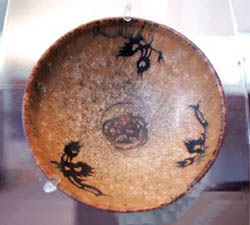
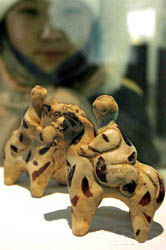
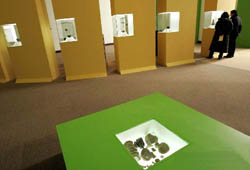
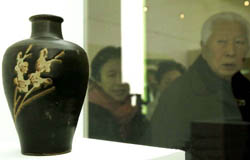
The story of a millennium-old kiln is being told at a very modern exhibition ongoing at the National Museum of China.
Entitled "Jizhou Kiln," it will run at the museum -- located to the east of the Tian'anmen Square -- until March 10.
The work of the young exhibition designer Jiang Mingwei, it gives a fresh new look, and one which differs significantly from those of most other exhibitions held at the National.
One of the most famous kilns in Chinese history, Jizhou was first built in Ji'an, in East China's Jiangxi Province during the late Tang Dynasty (AD618-907).
It reached its peak in the Song Dynasty (960-1279) and by the Yuan Dynasty (1270-1368) had fallen into oblivion.
The exhibition features more than 200 ceramics from collections at the National and from the Municipal Museum of Ji'an.
Excavations carried out in that area since the 1980s yielded the veritable treasure trove of fine artifacts on display and have shed light on the history of the ancient kiln, which had long remained a mystery. The exhibition reveals the story of the kiln from its early beginnings to date, with a focus on its most prestigious days in the Song Dynasty.
It was one of four major, privately owned kilns of the period, during which China's ceramic industry entered a new heyday following the well-known tri-colored glazed pottery tang san cai of the Tang Dynasty.
The three other kilns were those of Longquan, Yaozhou and Cizhou.
So prosperous was the ceramics industry during the Song Dynasty that kilns sprung up all over China.
In the world's art market today, the most prized ceramics come from the five famous court kilns of the time -- Ru, Guan, Ge, Ding and Jun kilns.
In the Yuan Dynasty, the ceramics center shifted to Jingdezhen in Jiangxi, where new varieties including blue and white, under glazed red and colored glazed porcelains emerged.
(China Daily February 16, 2005)