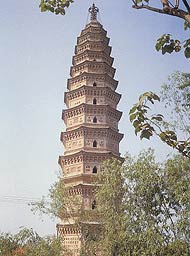
The pagoda was located in the former Xinghua Temple in the southeastern part of Mengcheng County. In the past, some ten thousand glazed Buddhist statues were inlaid on both sides of the pagoda's wails. Therefore, the pagoda is also called Wanfo (Ten Thousand Buddhas) Pagoda. The temple no longer exists, but the pagoda still stands on an island in the middle of a lake.
In the pagoda are two stone tablets with inscriptions about the pagoda's construction. One was installed on the fourth floor in 1102 and the other, on the eleventh floor, in 1106 of the Song Dynasty. Judging from the interval between the installation of the two tablets, it took four years to build the seven storeys. As the pagoda has thirteen storeys, the construction, including that of its pedestal and steeple, may have taken about ten years altogether.
The brick, octagonal multistoreyed pagoda is more than thirty-six meters high. There are doors on four sides and false windows on the others. The pent roofs of the second and third storeys were built into platforms, while those of the storeys above were made into balconies. Changes can be seen in the structure of the pagoda from the fourth floor. A staircase through the first three storeys changes to a spiral staircase on the fourth floor. In addition, the positions of doors and windows from the seventh floor up are irregular. Therefore construction may have been carried out in several phases.
The steeple of the pagoda is made of iron, but now only three tiers of iron discs exits. On the eleventh storey a four-meter section of a wooden pillar protrudes. Some of the ten thousand glazed Buddhist statues inlaid in the walls of the pagoda still remain. Judging from their style, most are the original statues, but some are reproductions.
As it followed the brick pagoda structure common in north China, it combined techniques of both northern and southern China and thus serves as a major example of pagodas of the Song Dynasty.