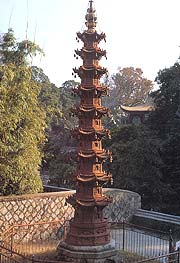
The pagodas, which are mammoth terra-cotta structures, are rare, the only such pair existing in China. They are unusual because they are huge, exquisite and ancient pottery pagodas.
Flanking the entrance to Yongquan Temple on Mount Gu in Fuzhou, the pagodas look as if they belong to the temple, but they were formerly situated in Longrui Temple on Nantai Island in Fuzhou. Later Longrui Temple was destroyed, making it hard to protect the two pagodas. In 1972 the relics preservation department had them moved to their present location.
The pagodas were built in 1082 during the Northern Song Dynasty, the year of their construction and their names were carved on them. The east pagoda is called Zhuangyanjie Qianfo Pagoda, while the west one is Puxianjie Qianfo Pagoda. The pagodas were made of best-quality clay and coated with a brown-red glaze. AS a result, their surface is glossy and they are therefore also known as the Porcelain Pagodas.
The pagodas, modeled after wooden multistoreyed ones, have eight sides and nine storeys. They are 6.83 meters high with a base diameter of 1.2 meters. Their shape is exceptionally ingenious and exquisite. Every part of the pagodas, including their main bodies, doors, windows, pillars, brackets, rafters and corrugated roofing, was made by moulding it after its wooden counterparts, then glazing and baking it in the kiln. The framework of the pagodas was baked part by part, then put together by means of dovetails, which not only facilitated the construction of the pagodas, but also made it easier to move and assemble them.
The ornaments on the pagodas are splendid. Sculptured on the wails are 1,078 images of Buddha. On the pedestals are vivid sculptures of celestial guards carrying a hundredweight, racing lions and flowers. Hung under the corners of the pent roofs are bells that ring when a breeze blows. The three-tiered steeples are calabash-shaped and crowned with a valuable bead. Carved on the bases are the year of the pagodas' construction and their names, as well as the names of benefactors and craftsmen who manufactured the pagodas. The pagodas are important not only for examination of the development of China?s ceramic technology.