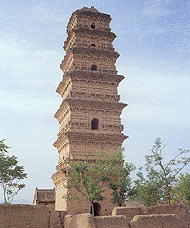
Outside Botaihou village, twenty-five kilometers east of Liquan County in Xianyang, a temple called Xiangji and a towering pagoda more than forty meters high once stood. Now no trace of the temple remains, but the pagoda, called Botaihou (Queen Mother Bo), is still there.
Why are the village and pagoda called Botaihou? According to a story, in the Han Dynasty the village was hit by an unprecedented natural calamity and the land produced nothing, but officials still pressed the villagers to hand in grain. One of Queen Mother Bo's maids happened to be from the village and pleaded with the queen mother on behalf of her fellow villagers. The queen mother conveyed the plea to her son, the emperor, and the village was exempted from grain taxes for three years. Hence the name to show gratitude.
The first storey of the square, brick, seven-storey pagoda is fairly high and has no ornaments. The front and back sides have arched doors. From the second storey up, there are brick pillars, balconies and balustrades on all four sides. All the pent roofs are built of brick and there are brackets under the eaves. The interior of the pagoda is tubular. Each storey from the first to the fourth has two doors on alternate sides. From the fifth storey up, each storey has four doors. Thus the designer attempted to prevent vertical fractures from occurring.
The exact date of the pagoda's construction is unknown, but from its shape and ornaments it could be a relic of the period between the Five Dynasties and the early Song Dynasty. It is invaluable because its shape and decorations are between those of the Song and Tang dynasties, and its first storey is higher than the other storeys, giving it the look of a multi-eave pagoda.