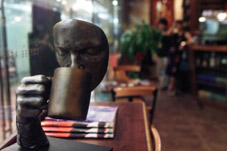
As for tea and coffee, most Chinese see the former as handed down from their ancestors, and the latter introduced from the remote West. Therefore, although the Chinese began to drink coffee long ago, most of them still choose tea as their lifelong "companion."
Nowadays, modern teahouses in China are still places where people go to socialize. Their elaborately decorated environment, gentle music, and amiable waiters and waitresses bring peace and comfort to their customers. Unlike these teahouses, various bars, crowded with boisterous floods of people throughout the night, and countless cafes are emerging in Chinese cities.
In the past, numerous old-style teahouses were scattered around China's cities and towns. Each teahouse vividly represented a miniature society as depicted in Lao She's drama Teahouse. However, few of these old teahouses exist today. Only a small number of them, which preserve their original appearance and nature, can now be found in the areas south of the Changjiang (Yangtze) River.
The old teahouses are remnants left by history. They are mostly single-storey houses, which have no name or signboards, and their interior decoration has a touch of the old, reminding us of the remote past. Beside each teahouse there are two big vats of water. Entering a teahouse in winter, one can find many customers wrapped in white vapor.
These old teahouses are equipped with old-fashioned, square or long tables as well as wooden stools. Waiters are busy serving customers, most of whom are elderly. While some play mah-jong here, others hold a teapot as they chat or listen in silence. The air is imbued with the mixed odor of tobacco and tea, which smells like burning musty straw. The elderly customers enjoy the special atmosphere of these teahouses, and believe it is more meaningful than the tea itself. Perhaps this is why they have been getting up before daybreak for decades to patronize these old teahouses, or perhaps it is the fragrant smell of these gathering places comforting their hearts that has kept them coming back.
The aroma of coffee has now spread across many of China's cities. Ten years ago, those who wanted to drink coffee had to drink instant coffee or spend 90 yuan at a star-rated hotel to enjoy a cup of cappuccino. Later, a chain of caf(&s named Starbucks appeared in shopping centers and office buildings, attracting more and more customers.
At first, most of Starbucks' customers were diplomats and their families, returned overseas Chinese, artists, and writers. Little by little, though, celebrities started frequenting the place and made drinking coffee fashionable. As some magazines have described, it feels comfortable to sip coffee while you sit by a window reading, thinking, or just enjoying life. Various caf(&s, such as the Old Tree Caf(& and UBC-Coffee, have followed the Starbuck's trend and have become places where people go to relax. Today, the customers of these caf(&s are no longer only those who are called Bobos, but people from all walks of life.
Hidden in the quiet towns of China, the surviving teahouses receive their regular customers, emit the mixed odor of tobacco and tea, and represent the lasting charm of South China as usual. While in large cities, various caf(&s continue to attract a different group of people. Despite their differences, both the green olives in white teacups served at teahouses and the slight acidity of Blue Mountain Coffee enjoyed in cafes add flavor to people's lives, arousing in them a rare affection for each another.
(China Pictorial July 8, 2003)