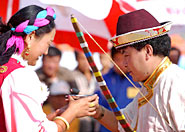
Late marriage has become an increasingly popular trend in the Tibet Autonomous Region, the largest Tibetan-dominated region in China.
Statistics released by the Chengguan District Civil Affairs Bureau in Lhasa, the regional capital, showed that more than 1,000 newly-weds are registered by the bureau on average each year. Their legally marriageable age averaged 25, older than the state required marriageable age for ethnic women at 18 and men at 20.
"The majority of the Tibetan newly-weds who prefer late marriage are well-educated and enterprising," acknowledged Ze Yong, director of the Chengguan District Civil Affairs Bureau.
Cering Doje, manager of a local listed company, said, " Youthhood is the prime time for one to build a bright career, and to have a successful career is the basis for his or her happy marriage."
The 31-year-old manager has been fully occupied with his work upon his graduation from Beijing-based Central Nationalities University a decade ago. He fell in love with several young ladies, but all of them parted with him simply because he was so engrossed in his profession.
Soinam Yanggyi, a Tibetan girl serving at a news network in Lhasa, recently turned 25 and got married. "I'd rather pick up the full-blown fruit on the love tree, than the bitter green one," she said.
Gaisang Yexe, a noted sociologist at the Tibet Academy of Social Sciences, ascribed a new life concept to the main reason for later marriage among the young Tibetans, apart from fast work tempo, better education backgrounds and improved living standards.
In old Tibet, many households, particularly those in outlying rural and pastoral areas, took early marriage as a useful and helpful way to increase their labor power, he added.
(Xinhua News Agency November 11, 2004)