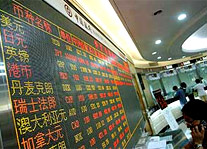
China abruptly on Thursday evening allowed the renminbi (RMB) to appreciate by a modest 2 percent, but said its exchange rate will not float by a big margin. The remark was apparently intended to ward off any speculation on further jumps.
The yuan has been pegged to the US dollar since 1994 at around 8.28 yuan to US$1. It is now trading at 8.11 yuan to US$1.
The overall aim of exchange rate reform is to build a managed, floating exchange rate mechanism based on market supply and demand and to maintain the yuan's stability at a reasonable equilibrium, the People's Bank of China (PBC) said.
Big ups and downs of the exchange rate are not in line with the fundamental interests of China since such fluctuations could threaten the country's economic and financial stability, the PBC added.
"This (the yuan's big ups and downs) will definitely not happen," the bank told the press.
The PBC listed the following reasons:
First, the RMB is no longer pegged to a single currency, but to a basket of currencies. The mutual changes of major currencies in the world market will keep fluctuations down.
Second, the international balance of payment will normalize itself with economic tools including the exchange rate playing a role in resource allocation, and streamlining foreign exchange supply and demand. These are solid foundations for a stable yuan.
Third, China's macro-economic policies will aim to provide a sound environment for the stability of its currency.
Finally, the PBC itself will endeavor to enhance its fine-tuning ability, improve foreign exchange management and keep the yuan trading at a reasonable equilibrium.
The PBC said that the exchange rate reform is designed to cater to the need of alleviating foreign trade imbalances, stimulating domestic demand, sharpening domestic enterprises' competitive edge globally and speeding up the country's reform and opening-up.
China's foreign exchange reserves skyrocketed to US$711 billion as of end June on the back of its trade surpluses. China still exercises foreign exchange controls, which means that enterprises cannot keep all of their foreign currency earnings and that a large part of foreign exchange inflows become the country's reserves.
Some developed countries, typically the United States, say that China, by artificially lowering the value of the yuan, gave its exporters an "unfair" advantage over everyone else, hurting the job markets in other countries.
But the PBC said the Chinese government always maintained an "independent and highly responsible" attitude towards the exchange rate issue.
China adheres to choosing an exchange rate system that caters to its domestic situation by taking into consideration of its fundamental interests and economic and social development, the PBC added.
Meanwhile in Hong Kong, Stephen Ip, the special administrative region's acting financial secretary, welcomed the latest reform, but added that Hong Kong would keep its currency pegged to the US dollar.
"The government has no intention at all of changing the Linked Exchange Rate system, which has served Hong Kong well for more than 21 years and has been the anchor of our economic stability," Ip said in a statement.
"Hong Kong's financial and monetary systems are well established and well prepared for changes of this kind," Ip added.
According to Ip, the reform of the RMB regime is also likely to benefit the economy of Hong Kong. These benefits include greater competitiveness in Hong Kong's exports to the Chinese mainland and the stability brought by more sustainable economic development of the mainland.
A stronger RMB will also raise the purchasing power of mainland consumers and this is likely to benefit Hong Kong's exports to the mainland. Hong Kong's inbound tourism will also benefit as more mainland visitors will spend more in Hong Kong, Ip added.
According to Joseph Yam, chief executive of the Hong Kong Monetary Authority, the recent refinements introduced to the Linked Exchange Rate system have strengthened the authority's ability to deliver monetary stability in Hong Kong and to handle the impact of capital flows arising from changes to the RMB exchange rate regime.
"The financial market in Hong Kong is not volatile," Yam added.
(Xinhua News Agency July 22, 2005)