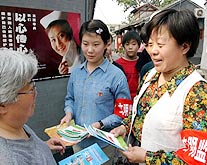
The democratic drive for local governance made a significant step forward with the establishment of a sub-district-level representative assembly Monday in Beijing.
The representative assembly, consisting of 233 representatives elected from more than 60,000 residents of Lugu Community in western Beijing's Shijingshan District, is the first sub-district-level self-government organ in the capital city.
Moreover, a 37-member of autonomy committee was elected by representatives on Sunday, which will be in charge of public affairs and social services in various fields, such as culture and education, medical and health work, environmental protection, mediating civil disputes, and helping maintain public order.
Previously, these tasks belonged to a government agency called the sub-district office of Lugu, said Han Mengrong, an official of the sub-district office.
Meanwhile, the representative assembly also takes the responsibility to convey residents' requests and opinions to government offices, as well as supervising and evaluating its performance.
Han said the establishment of the representative assembly not only helped realize a limited form of government, but also provided a stage for local residents to participate in the management of their own community.
Moreover, the newly-elected autonomy committee also includes representatives for migrant people, which account for 20 percent of Lugu residents, said Han.
Yang Xuedong, an expert with the China Center for Comparative Politics and Economics, said the establishment of the Lugu representative assembly has great significance for democratic governance in urban communities.
He said that following the establishment of directly elected villager committees in China's far-flung rural areas since the early 1980s, the democratic reform of local governance in urban communities has also made progress in recent years.
Many neighborhoods consisting of hundreds of households under the sub-district level have already set up their own residential committees which were elected by local people, and are grassroots self-government organs for urban people, according to Yang.
"I think it is of great significance for the establishment of the sub-district representative assembly, which widens the scope of local autonomy, and people may have more say in the governance of local affairs," said Yang.
Other large cities like Chongqing, Nanjing and Shenyang are also taking measures to expand self-government boundaries at the sub-district level, consisting of thousands of households rather than the hundreds organized into small-sized neighborhoods.
(China Daily October 14, 2003)