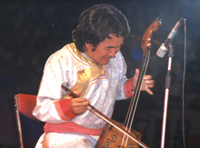
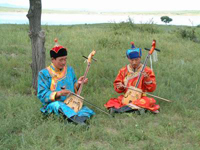
The Mongolian ethnic group has a great musical heritage of which playing and performing is often seen as its characteristic. There are many musical folk instruments in Inner Mongolia, including sihu (four-stringed fiddle)、sanxian (three-stringed guitar)、dizi (bamboo flute)、huobusi (pipa-shaped four-stringed fiddle), and the most famous, matouqin, or morin hort (horse head two-string fiddle) as it is known in Mongolian.
Matouqin is a bowed-string musical instrument that got its name from its horse head-shaped scroll. It has an expressive, gentle timbre, which produces a deep and mellow sound. It can be played as a solo instrument, or with an ensemble, or as the accompaniment to Mongolia folk songs and dance. It sounds both joyous and sad, and at times, expansive and unrestrained, like a wild horse neighing. It plays pleasing and moving music that sounds like a breeze in the grasslands that can be intoxicating to hear. The herdsmen say, "There can't be songs without accompaniment by a Matouqin."
On the Mongolian grassland there is a legend. Long, long ago, a boy named Suhe in Inner Mongolia owned a pleasing voice and a gentle heart. All the people that knew him liked him. He and his grandmother depended on each other in order to eke out a living. One day, he saw a newly-born but dying foal. He picked it up and brought it home. He took care of it and brought it up to be a beautiful strong white horse. One night while wolves attacked his sheep herd, the horse risked its life to protect them.
And with time passing, Suhe became a handsome young fellow. One spring, the local lord held a horse race and said that he would marry his only daughter to the champion. Suhe won the game, but the lord broke his promise because Suhe was only a herdsman with no money or power. But the lord took a fancy to the white horse and wanted to buy it from Suhe. Suhe was angered by this and said, "I'm not here to sell my beloved horse but to take part in the horse race. I don't care whether you will marry your daughter to me or not, but please let me go." The lord's button man punched him and threw him out on to the grassland. He kept the horse. Two days after Suhe got back home, his loyal horse returned with arrows all over its body, and died in its owner's arm.
Suhe was very sad and missed his white horse day and night. One night the dead horse came back into a dream, saying, "Make a musical instrument with my body. Then I can accompany you for ever and will never fell lonely again." So, the first type was made, with the horse bone for its neck, and horsehair as its strings, horse skin covering its wooden sound box, and its scroll carved into the shape of a horse head.
The origin of the matouqin is just a beautiful legend, it expresses the herdsmen's simple love of their horse, their music, their grassland, and their lives. But the real matouqin originated in the xiqin, an ancient musical instrument of northeast China.
The instrument has quite a few other names in both Mongolian and in Chinese, in different areas. It is used beyond the Inner Mongolian region and can be seen in other Mongolian living areas such as northeast and northwest China and even in the Xinjiang region, popularized in the Mongolia ethnic group during the 13th century. Marco Polo (1254-1324), the Italy traveler who went to Yuanshangdu (the Upper Capital of Yuan Dynasty, located nowadays in Inner Mongolia) in 1275, brought a matouqin to Europe, that helped the progress of stringed instruments in Europe.
Herdsmen make the matouqin not only as a musical instrument, but also as a sacred thing. Herdsmen say that after a female camel gives birth to baby camels, the mother camel often refuses to feed their babies. Herdsman will then invite matouqin players to play music to the mother camel. The mother seems moved by the music, and will then call the baby camels softly and feed them with her milk. True or not, the herdsman's love of the matouqin and its music is understandable - they believe the music is sacred and matouqin divine.
The matouqin is always made by the player himself. Every matouqin born in the grassland is an exultant, celebrated thing. According to local custom, people hold great accomplishment ceremony for the beloved matouqin. They hope the music god will give the fiddle the most beautiful sound. They put the new matouqin at the center of a table in a yurt and cover it with a hada (white silk scarves which are tokens of greetings in Inner Mongolia). They invite a folk poet to uncover the hada, and daub the matouqin with chosen butter. Then he'll bow to the matouqin, hold up a silver bowl with milk wine, and read the greeting words loudly. Finally, the player will play it for all the people that took part in the ceremony.
(China.org.cn by staff reporter Chen Lin, October 4, 2003)