If someone could read the strange pictographs on a yellowing book of some 30 pages, he or she could not only pick up a 10,000-yuan reward, but also be privy to understanding the birth of the Chinese written language, thousands of years ago.
 |
|
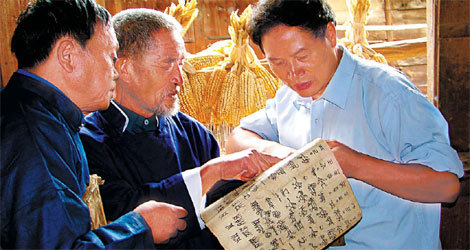
Pan Chaolin (right) examines a document with the help of two Shuishu masters.
|
However, that may not happen any time soon, going by the travails of Pan Chaolin, the owner of this rare book. He has been journeying with it to remote mountain villages in Southwest China's Guizhou province in the hope of finding someone who can decode the 1,500 strange words in the book titled, Chanting of the Nine Stars (Jiu Xing Song Du).
A mirror-image of ancient Chinese characters, this language of the Shui minority, also known as Shuishu, has been attracting growing international attention in recent years. But researchers are now racing against time to protect it from disappearing altogether.
The Shui is a small ethnic minority of some 400,000 people in Guizhou Province. Like many of China's 55 minorities, it also has a long, mysterious past. It is commonly believed that the ancestors of the Shui people lived in the Central Plains thousands of years ago, until wars drove them south.
Of the 17 Chinese minorities who have their own traditional written language, the Shui and the Naxi people, who live in Yunnan province, are the only two minorities that use pictographs.
The Shui language attracted attention even before the better known Jiaguwen - a pictographic inscription on animal bones and tortoise shells used in the Shang Dynasty (16th-11th c BC). Jiaguwen first came to notice around 1900 and has been seen as the embryo of the Chinese language.
However, Jiaguwen is highly abstract and researchers believe it must have evolved from older characters.
As early as 1860, Shuishu had attracted Mo Youzhi, a famous scholar of Guizhou, who speculated that Shuishu was an ancient language that had existed before the time of Qinshihuang, the First Emperor of the Qin Dynasty (221-206 BC).
But contemporary researchers have argued that Shuishu developed from Jiaguwen. However, this year, Shui scholar Wei Zhangbing, who is based in Dushan county of Guizhou, raised a more daring theory.
In his new book, Glimpses into China's Shuishu, Wei said Shuishu was the source of the Chinese language and was present in an ancient book mentioned by Confucius (551-479BC) as very important but had long been lost.
Furthermore, Wei said that Gong Gong, a legendary tribal leader who fought against other tribes long before the Xia Dynasty (c.21st century-16th century BC), was the ancestor of the Shui people.