China reaps benefits of 'frugal' space program
- By Yan Xiaoqing
 0 Comment(s)
 Print
Print E-mail
China.org.cn, November 4, 2011
E-mail
China.org.cn, November 4, 2011


China's manned space program started in 1992. Since then, China has spent 35 billion yuan on the program in 20 years. Although high, this figure is still less than the U.S. spends on its comparable space program in one year.
 |
|
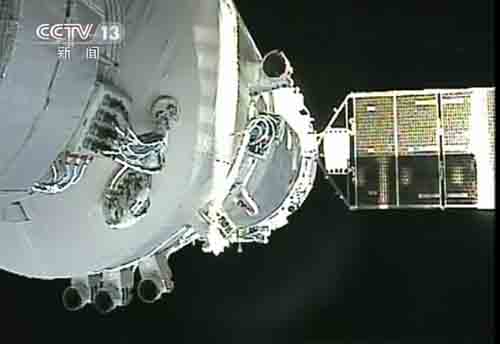
China's spacecraft Shenzhou 8 and space station module Tiangong-1 accomplished the nation's first docking operation early Thursday. |
According to data from the Manned Space Program Office, the program cost 20 billion yuan between 1992 and 2005, during which time the Shenzhou-6 spacecraft was developed and subsequently launched; from 2005 up to now, 15 billion yuan has been spent on the program.
According to Zhou Jianping, the current chief designer of China's manned space program, the U.S. spends as much on its space program in one year as China spends on its program in 20 years. Zhou stated that, in recent years, NASA's annual budget has been roughly US$17 to US$18 billion. Russia has also been increasing spending on its space program year-by-year. Zhou commented that Japan and Europe have also maintained their space program budgets.
Zhou went on to say that, as China is currently the world's second-largest economy, it is normal for the country's aerospace industry to develop in line with its economy, especially if the industry is considered an industrial system.
Zhang Bonan, the chief designer of China's spacecraft, commented that both the U.S. and Russia began their manned space programs decades ago and, have, over time, developed the unmanned spacecraft, the single-person spacecraft, and finally the multi-person crewed spacecraft. "China's manned space program started late, but we started on the basis of that earlier research and have developed rapidly," he said. "That is why we have saved a lot on research and development so far."
The Shenzhou mission has implemented an innovative docking plan. The U.S. and Russia used to launch two spacecraft each time to complete one docking. However, China's Tiangong-1 spacecraft will separately dock three times with three different spacecrafts. The Shenzhou mission, therefore, requires two fewer launches than the U.S. and Russian missions.
According to U.S. and European research institutions, every dollar invested in the aerospace industry will yield 7-12 dollars in return. In 1960s, the U.S. "Apollo" program received over 3000 patents and contributed greatly to the development of the U.S. high-tech industry. In addition, more than 30,000 consumer products were developed directly from, or as a result of sharing the technology used in spacecraft development.
China's aerospace development has also generated a significant profit. Over 2,000 space technologies have been implemented in the telecommunication, textile, petroleum, transportation, medical treatment and agriculture industries. As a result, almost every Chinese person is reaping the benefits generated by the country's aerospace industry.


