A giant surrealistic tower, erratically skewed, points at the sky on top of a 960-meter hill 170 kilometers northeast of Beijing.
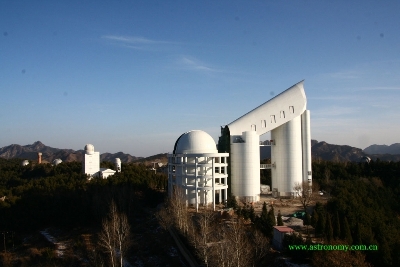
The white structure, with a wide dome at its lower end, looks more like a missile silo. Chinese scientists have built the world's most powerful optical telescope in a research base of the National Astronomical Observatories, Chinese Academy of Sciences (NAOC), expecting to unravel the mysteries of the universe.
The advanced astronomical facility, which cost 235 million yuan (34.4 million U.S. dollars) from the national research fund, has an effective aperture of over four meters, the biggest of its kind in the world, and 4,000 optical fibers that can simultaneously track space and decode starlight into enormous amounts of spectrographic data.
With its specifications, the Large Sky Area Multi-Object Fiber Spectroscopic Telescope (LAMOST), the official monicker of the mammoth device, can see at least twice as far into space and measure more spectral emissions than the previous No. 1 which inspired LAMOST, the Sloan Digital Sky Survey (SDSS).
Prof. Cui Xiangqun, lead engineer for the ambitious project, said in an interview Wednesday with Xinhua, LAMOST combines both large clear aperture and wide field of view into one single sky-monitoring instrument, which enables the highest spectrum acquiring rate in the world.
The team of engineers, which grouped the country's most talented telescope builders, mounted a four-meter segmented reflecting mirror at the lower end of the building. During observation nights, the upper parts of the dome would be removed, starlight would be reflected from the lower mirror up through the 20-meter tube to a 6-meter primary mirror. Then the light of space is fed into the front ends of optical fibers accurately positioned on a focal plane, before real-time data are recorded into spectrographs fixed in a room underneath.
"We need to change the shape of the reflecting mirror during tracking in order to eliminate the spherical aberration of the primary mirror for more precise recording of spectra," said 57-year-old Prof. Cui, who heads the Chinese Academy of Sciences (CAS) Nanjing Institute of Astronomical Optics and Technology.