The world's largest computing grid is launched on Friday, ready to tackle mankind's biggest data challenge from the earth's most powerful accelerator, according to local media reports.
 |
|
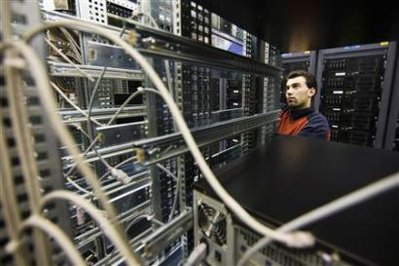
A technician performs maintenance in the CERN LHC computing grid centre in Geneva, October 3, 2008. This centre is one of the 140 data processing centres, located in 33 countries, taking part in the grid processing project. More than 15 million Gigabytes of data produced from the hundreds of millions of subatomic collisions in the LHC (Large Hadron Collider) should be collected every year. [Valentin Flauraud/Reuters] |
Three weeks after the first particle beams were injected into the Large Hadron Collider (LHC), the Worldwide LHC Computing Grid (WLCG) now combines the power of more than 140 computer centers from 33 countries to analyze and manage more than 15 million gigabytes of LHC data every year.
The United States is a vital partner in the development and operation of the WLCG. Fifteen universities and three U.S. Department of Energy (DOE) national laboratories contribute their power to the project.
"The U.S. has been an essential partner in the development of the vast distributed computing system that will allow 7,000 scientists around the world to analyze LHC data," said Glen Crawford of the High Energy Physics program in DOE's Office of Science.
"Particle physics projects such as the LHC have been a driving force for the development of worldwide computing grids," said Ed Seidel, director of the U.S. National Science Foundation's Office of Cyberinfrastructure. "The benefits from these grids are now being reaped in areas as diverse as mathematical modeling and drug discovery."
When the LHC starts running at full speed, it will produce enough data to fill about six CDs per second. Dedicated optical fiber networks distribute LHC data from CERN in Geneva, Switzerland to 11 major "Tier-1" computer centers in Europe, North America and Asia. From these, data is dispatched to more than 140 "Tier-2" centers around the world.
Physicists in the United States and around the world will sift through the LHC data torrent in search of tiny signals that will lead to discoveries about the nature of the physical universe. Through their distributed computing infrastructures, these physicists also help other scientific researchers increase their use of computing and storage for broader discovery.
"Grid computing allows university research groups at home and abroad to fully participate in the LHC project while fostering positive collaboration across different scientific departments on many campuses," said Ken Bloom from the University of Nebraska- Lincoln, manager for seven Tier-2 sites in the United States.
(Xinhua News Agency October 4, 2008)