The country's lunar probe blasted off towards the Earth's only
satellite yesterday evening on a 380,000 km journey that is a
decisive step in the nation's quest to explore "deep space".
The one-year voyage, Asia's second after Japan's Selene probe
took off on September 14, was nearly half a century apart from the
world's first lunar flyby by a Soviet Union orbiter.
But Chang'e I the orbiter is set to conduct research not yet
done by orbiters from other countries, Chinese scientists said.
Over the past 30 years, China has achieved space feats a
developing country could have only dreamed of: sending satellites
of different sizes and shapes into orbit, and carrying out manned
missions.
The ringing successes may help elevate China as a space-faring
country, but it still has challenges to overcome to fulfil its
ambitions and aspirations of pursuing technological innovations and
testing its scientific limits.
"Launching man-made satellites, manned space flights and
conducting deep-space exploration constitute a trilogy of space
activities," Ouyang Ziyuan, chief scientist of China's lunar
exploration program, said.
Sun Laiyan, director of the China National Space Administration,
had said earlier that the moon could be used as a "relay station"
from which scientists can travel further to the frontier.
In other words, the moon provides a good platform to launch a
probe into outer space.
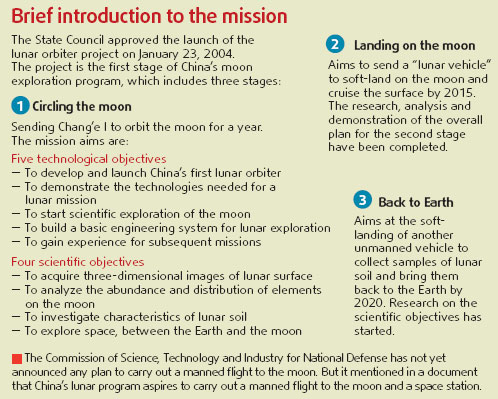
China officially approved its lunar probe program in 2004, with
its first step being the launch of a satellite to orbit the
moon.
An unmanned moon landing and the launch of a moon rover around
2012 will follow.
Ye Peijian, chief designer and commander-in-chief of the
satellite system of the country's lunar probe program, said the
Chinese program started relatively late, but it has a high starting
point.
"Our first step is to circle the moon, not a flyby," he said.
"Besides, we have clear-cut scientific objectives, some of which
have never been done successfully, or not attempted at all," Xinhua
quoted him as saying on the eve of yesterday's launch.
Chang'e I uses stereo cameras and X-ray spectrometers to map
three-dimensional images of the moon's surface.
"Three-dimensional imaging of the whole moon in a real sense has
not been done before," Ouyang Ziyuan said in his book Introduction
to Lunar Science.
Chang'e I will also be the first to use its microwave sounders
to gauge the thickness of lunar regolith (soil).
In addition, the orbiter will analyze abundance and distribution
of elements, nine of which are yet to be identified, on the lunar
surface, said Sun Jiadong, who is the chief designer of China's
lunar exploration project.
With these new features, Chinese scientists said they believed
the exploration's results would provide new materials for lunar
studies and investigation of the moon's resources.
(China Daily October 25, 2007)