Tibetans begin rebuilding damaged sacred mound
 0
0 


The world's largest Mani Stone Mound and a few monasteries - two features of Tibetan Buddhism - were among the hardest-hit in Northwest China's quake-ravaged Yushu, Qinghai province.
 |
|
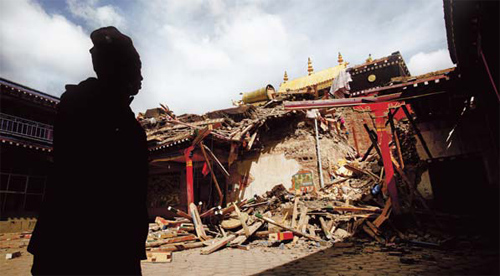
?A Tibetan stands in front of the remains of the Gyegu Monastery, the largest Sakya monastery in quake-hit Yushu county. |
Established more than 200 years ago, the Mani Stone Mound in Yushu, the largest of its kind in the world, was badly damaged during the earthquake, as millions of Mani stones fell down and three of its eight pagodas collapsed. Cracks can be seen in the other five.
The site, comprised of more than 2 billion pieces of Mani stones engraved with inscriptions concerning law, calendar calculation, art theory, sutra texts and Buddha carvings, is about 283 meters long, 74 meters wide and 2.5 meters tall.
Mani stones are sacred to Tibetans. In this vast, wind-swept plateau that is sparsely populated with Tibetans, such stones are usually placed along roadsides and rivers, or piled up to form mounds or long walls, and become shrines for prayer.
Apart from the Mani Stone Mound, monasteries in Yushu suffered great damage in the quake, too.
A hall collapsed at the Gyegu Monastery and the other buildings are regarded as too dangerous for the monks to stay there. "All the monks now live in tents," said Sonam, a 25-year-old monk who studies at the monastery.
The Thrangu Monastery, also in Yushu, is thought to be the hardest hit among all the county's temples. Of 260 monks at the monastery, 23 died and another 17 were injured, according to a report from China National Radio.
The biggest hall there is on the verge of collapsing as a result of cracked walls, while the surrounding buildings have been reduced to rubble, monks said.
Almost all of the monastery's buildings disappeared after the quake, including bedrooms for all of the 260 monks, two meditation centers and at least three halls, said Kunga, a student at a Buddhist college founded by the monastery.
"My biggest hope is that people will help us rebuild our monastery," said Kunga.
Guo Hong, deputy director of Qinghai's provincial bureau of cultural heritage, said almost all the immovable cultural relics in Yushu have been damaged.
She said local authorities have been urged to evaluate the detailed damage to historic and cultural relics in the quake and to draw up plans for their restoration.
"The State Administration of Cultural Heritage has also sent a team here to help with the assessment and restoration work," Guo said.
Official figures show rescue workers and soldiers have salvaged some 1,000 Buddha statues and several thousand sutra texts.
The residents of Yushu have taken some action, too. They have begun to take plates and rocks to the Mani Mound in an effort to restore it.


