Xie Lingxia always carries three travel cards in her purse, for the respective transport systems of Guangzhou, Shenzhen and Hong Kong.
A worker at the Hong Kong office of Danish shipping firm Maersk, Xie said: "Often I'm in Hong Kong, Shenzhen and Guangzhou on the same day.
 |
|
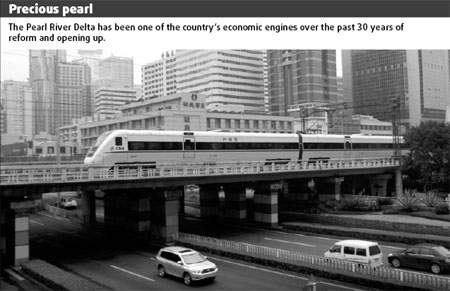
An Shenzhen-bound express train leaves Guangzhou. [China Daily] |
"My husband works in Guangzhou, so sometimes I start the day in Hong Kong, go to Shenzhen in the afternoon, and end up in Guangzhou," she said.
"The transport system is great, especially the express train, but that's expensive.
"I used to think about applying for a job at the Guangzhou office to be close to my husband, but I can earn more money in Hong Kong and with the good transport system, traveling is easy," she said.
Last week at a meeting of the Guangdong political consultative conference, Governor Huang Huahua said the province has budgeted 80 billion yuan (US$11.7 billion) for the initial phase of an intercity light rail project linking Guangzhou with Dongguan, Shenzhen and Zhuhai, the other major cities within the delta.
The government will spend 350 billion yuan to build a rail network stretching 1,900 km in the Pearl River Delta region by 2050, he said.
The Guangzhou-Zhuhai intercity light rail project and Guangzhou-Foshan metro project, with a total cost of 27 billion yuan, are due for completion in 2010, he said at the conference.
Meanwhile, the Guangzhou-Dongguan-Shenzhen, Dongguan-Huizhou, Guangzhou-Huadu-Qingyuan, and Zhongshan-Nansha-Humen projects, costing 70 billion yuan, will open in 2015, he said.
The total length of track lines will be 1,100 km by 2012, he said.
"The projects are designed to integrate the transport infrastructure and shorten travel time between Guangzhou and any other city in the delta region to less than an hour," Huang said.
The province has also budgeted 220 billion yuan for the construction of expressways network in the province, he said.
By 2012, the region will have 3,000 km of expressways, he said.
Ding Li, a researcher with the Guangdong Academy of Social Sciences, said: "The decision to increase spending on transport infrastructure will help boost demand amid the financial crisis and flatten the traffic bottleneck that would otherwise challenge Guangdong province's development in the future.
"An integrated network will also change the way people live," he said
They will be able to live in a place where housing is cheap, but work in another, Ding said.
(China Daily January 9, 2009)