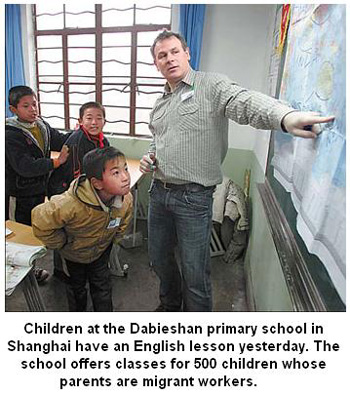
About 70 percent of the children of migrant workers in Shanghai
will receive free primary and middle-school education at public
schools by 2010, the Shanghai municipal education commission
said.
There are about 140 million migrant workers nationwide, and their
choices for how they look after their children are reduced to
either leaving them behind or bringing them to live in their rented
homes in the cities.
However, those who study in cities do not enjoy the same tuition
policies as actual city residents because tuition benefits are
considered a form of public welfare for permanent residents.
Given its large migrant population, Shanghai has been pursuing
multiple policies to help the children of its non-permanent
residents.
As of last September, 379,980 children of migrant workers were
receiving compulsory education in the city.
Of that number, nearly 220,000 were in public schools. The rest
were in private schools.
"This year, more children of migrant workers will be enrolled at
public schools," Yin Houqing, vice-director of the Shanghai
municipal education commission, said.
"All districts in the city will leverage their own education
resources and allocate adequate room at public schools for migrant
workers' children. Meanwhile, the local government will also
provide education subsidies."
"Since junior middle school education requires more attention
from teachers and education equipment, most of the schools built
specially for the children of migrant workers fall short of what is
needed," Yin said.
Migrant children who study at public schools are treated the
same as other children when it comes to school registration,
government subsidies and exemptions from tuition fees.
The Ministry of Education asked its local departments at the end
of last year to ensure that all children of migrant workers are
enrolled in public schools and enjoy the same tuition policies as
permanent residents do.
However, limited resources have made it necessary for
educational authorities to look beyond public schools.
"Crowded classrooms at public schools have made it difficult to
enroll all the children of migrant workers. Private schools should
enroll more of them," Yin said.
Shanghai has set up 258 private schools for the children of
migrant workers. More than 160,000 such children study in private
schools.
"The city will provide more support and services to private
schools, and special funds will be earmarked to ensure that migrant
children have access to quality education and lower tuition," Yin
said.
(China Daily February 13, 2008)