By Lisa Carducci
"The role of an imam is to set an example for Muslims. If he doesn't, it is useless to be an imam." This is one of the first sentences uttered by Abdurakip during our two-hour talk, as soon as I returned to Urumqi from north Xinjiang. He had been very busy in recent days, having returned the day before from Turpan where he was born and raised. Just before meeting me he had met with a Shanghai delegation that wanted to know more about Islam in Xinjiang. Despite the rushed situation, he didn't show any impatience or fatigue and answered all my questions with the smile of a man who speaks of what he loves and what motivates him.
|
|
|
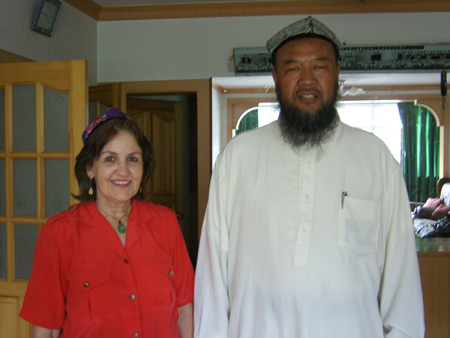
Lisa(L) and Abdurakip(R) [Foreign Languages Press]
|
Abdurakip is his Uyghur name. Damullah indicates that he is an imam of the highest level, and Hadjim (superior to Hadji) shows that he has accomplished the ritual pilgrimage, or hadj, to Mecca.
Born into a rural family, he attended a Chinese language school. At the end of high school in 1979, he didn't pass the university admission exam. His disappointed mother wanted to make a useful man of her son and introduced him to imams. The young man began studying Islam under their guidance. "When Deng Xiaoping, the engineer and initiator of the China's reform and opening up, declared that religious belief is a human right and a personal choice, and that religious practice must be protected by the Chinese Constitution," stated Abdurakip, "I decided to throw myself into the study of Islamic texts and to become an imam," adding, "We no longer live in the time of the 'cultural revolution,' when religion belonged to the old ideas that China had to get rid of." Today, most religions are present in Xinjiang.
Abdurakip speaks perfect Chinese and Uyghur, and good Arabic, as he studied in Egypt. Most Muslims, according to him, know enough Arabic to make it the language in which they pray. From 1980 to 1990, he was instructed by imams in several cities. Between 1991 and 2001, he himself was an imam in Turpan's Shanshan County at the Id Kha Mosque. One can also see the synonymous terms Idkah, Idgar, or Atigar, which mean "a place to celebrate festive days."
How does the day of an imam unfold? His role consists in guiding his Muslim brothers and in leading them in the practice of their faith. This starts with the five daily prayers: Bamdat, Piexin, Digar, Sham, and Hoptan, which are recited, respectively, half an hour before sunrise, at 13:00, at 17:00, at sunset (a different time every day), and, finally, some time after Sham that last until dawn the next morning. Each session lasts half an hour and is preceded by ritual ablutions. "The imam absolutely must go to the mosque to pray. If he prays alone at home, he doesn't set an example for anyone," said Abdurakip. Also, he must wear the appropriate turban and robe.
The other Muslims – the common faithful – take part in the prayer whenever possible or they delegate a family member to replace them. At each prayer session, between three and 100 persons attend the mosque. The others pray at home or in their hearts.
Friday is a sacred day, al-jumu'a, a word from Syriac language meaning "day of reunion". Thousands of believers go to the mosque at 12:30 to listen to a 30-minute teaching in the local language, which is Uyghur or Kazak, or Chinese for the Hui. It is the imam's function to explain the scriptures and to remind them of rules such as respecting women, assisting parents, and so on. Half an hour of prayer in Arabic follows this. Those who don't know the language comport themselves quietly and listen. Advanced students or imams-in-training lead the ceremony, while senior imams stand behind to observe and correct them. Regardless of the weather – wind, snow, rain, or heat – the mosque is full, as well as the outside square. "This accommodates 10,000 people, and this is not an exaggerated number."
The rest of the time, the imam attends to his personal work: the farmer cultivates his land, the merchant looks after his business, and so on. As for Abdurakip?Damullah Hadjim, he functions as the director of the Xinjiang Islamic Studies Institute and is also a professor. He teaches 10 hours a week. The 170 students are all male. How does one become a Muslim? "By conversion, such as for a Han who wants to marry a Muslim woman, or by birth to a Muslim family," the imam explained. "There is no special ceremony at birth. The child is trained to practice little by little, but he has no obligation before the age of 18. But afterwards, if he fails to fulfill his duty, he will be punished." I then asked which sanction awaits the young man, and the imam answered, "Such a man will never reach happiness; he will have a miserable life."
