 |
|
Staff workers at the Dujiangyan Funeral Parlor of Sichuan Province are making comparisons of victims' DNA. [File photo]
|
Liu Liangzhi, head of the Dujiangyan Funeral Home, recalls about 200 dead bodies arriving each day the first week after the earthquake.
"The number of bodies was beyond our crematorium's capacity," Liu says. With six cremators, the funeral home could only cremate 36 bodies a day. "We had to work 24 hours a day," Liu says.
The dead bodies soon occupied the funeral home and there was no time for any ceremony demanded by Chinese tradition.
The Investigation Department of Chengdu Public Security Bureau mapped out a plan to identify the victims on May 14 and dispatched 54 forensic doctors to the earthquake zones in the city. About 30 forensic experts collected DNA samples from the dead at Liu's crematorium.
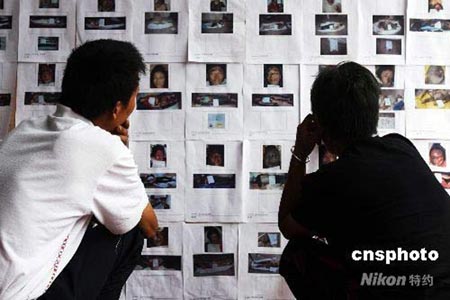
Ding Yong, a forensic expert from the investigation department, says they first photographed the bodies and then collected DNA samples.
"For each body, we took three pictures, full figure, face and birthmarks or objects found on the bodies," Ding said.
If the body was still warm, forensic workers took blood samples. From decaying bodies, cartilage, tooth or bone was collected in an ethanol-filled tube. The samples were all coded with numbers.
By last September, the forensic experts in Chengdu had photographed 585 bodies or taken DNA samples. Some bodies were immediately identified by relatives at the funeral home.
Xue went to Dujiangyan police station to have his blood test taken for DNA identification two weeks after the quake, in the hope of finding his missing mother.
All the blood tests were taken free of charge, says Mao Jiong, director of the DNA lab of the investigation department,
Mao says more than 100 samples were sent to his lab on the first day of their work. The lab has only two DNA sequencers and five staff and they worked 24 hours to collect data from the samples.
To confirm identification, samples are required from direct relatives -- parents or children -- to match DNA data. But some victims had only one or no direct relatives, so investigators contacted siblings for DNA sequence analysis, explains Mao. It took a week to get the matching results.
"Our priority principle is to be extremely cautious and allow absolutely no mistakes," Mao says. "This is our responsibility to the victims as well as to the survivors."
About two weeks after the earthquake, families started to come to the lab to have blood tests for DNA matches as the nine funeral homes in the city that had posted photos of the coded bodies for relatives to identify.
