Partial transfer of gov't powers set to challenge laws
- By Elaine Duan
 0 Comment(s)
 Print
Print E-mail China.org.cn, March 8, 2012


|
|
|
Wang Yang, Party Secretary of Guangdong Province, answers media questions on the open day of the Guangdong delegation during the on-going NPC session. [Photo: Beijing Times] |
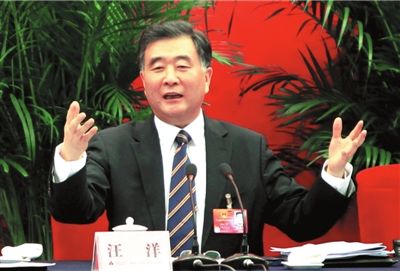
The partial transfer of government power from central control to social organizations could highlight the limitations of current laws and regulations, Guangdong Provincial Party Chief Wang Yang said during a panel discussion attended by the Guangdong delegation in Beijing on March 6.
Wang identified it as the single greatest difficulty facing government devolution and expressed hopes that related plans would have the support of the central government.
As of the end of October 2011, Guangdong Province had registered 30,535 social organizations. However, according to Zhong Nanshan, a deputy to the on-going National People's Congress session, most failed to play an effective role. Zhong added that government agencies often become confused about the scope of their functions, making it difficult to involve local organizations unless political institutions are reformed.
The province is currently working on reforming the administrative approval system with the aim of handing parts of government power to local organizations, according to the province's governor Zhu Xiaodan.
Wang stated that provincial government bodies are currently submitting proposals for approval and a new commission comprising specialists and retired government leaders has been set up to look at what powers could be transferred to the local organizations.
However, Wang added that current legislation has clearly outlined the powers of each government agency and legalized the interests of different government sectors. He said that contact was being made with concerned ministries of the State Council in a bid to seek a legislative breakthrough.
In contrast with Wang's approach, Zhong proposed a bottom-to-top reform which does not rely on any breakaway or shift of power from the central government. Zhong referenced Guangdong's initiative in the exercise of joint stock company ahead of the opening of the 15th Party Congress in 1997, when the concept was still fresh among delegations from other provinces.
Wang disputed the merits of the proposal, saying that the current reform of the government system differs from the earlier economic restructuring as the earlier one primarily involved provincial interests, while the current devolution plans might affect the interests of different government sectors.


