China launches first crewed mission for space station construction
 0 Comment(s)
 Print
Print E-mail Xinhua, June 17, 2021


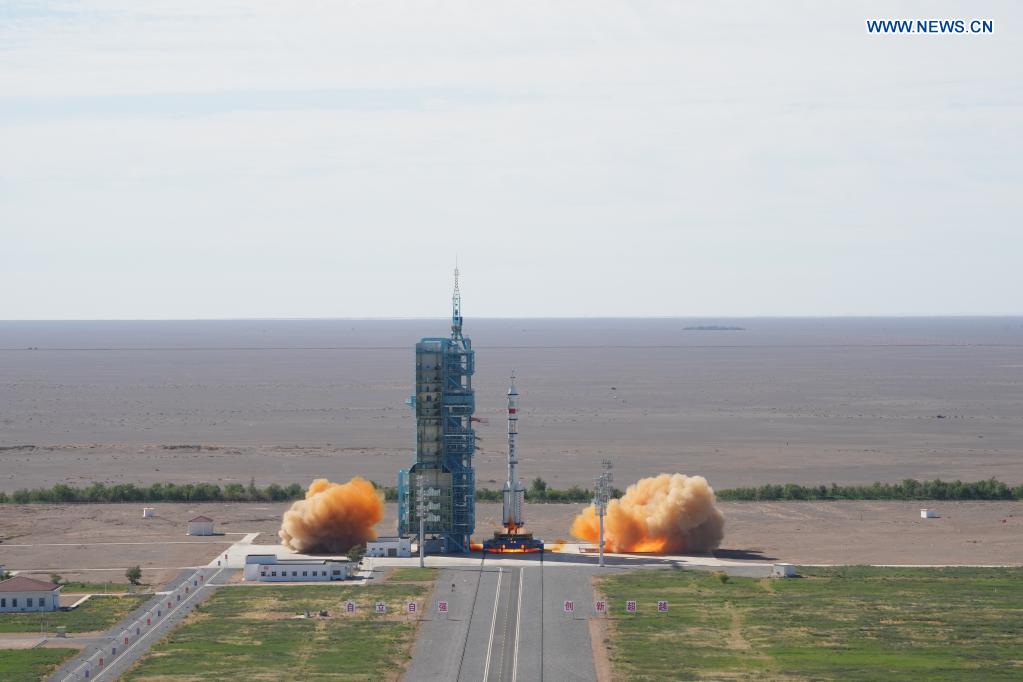
China on Thursday launched the crewed spacecraft Shenzhou-12, which is expected to send three astronauts to its space station core module Tianhe for a three-month mission.
The spacecraft, atop a Long March-2F carrier rocket, was launched from the Jiuquan Satellite Launch Center in northwest China's Gobi Desert.
It is China's seventh crewed mission to space and the first during the construction of China's space station, according to the China Manned Space Agency (CMSA). It is also the first in nearly five years after the country's last manned mission.
The three astronauts are commander Nie Haisheng, a 56-year-old veteran who participated in the Shenzhou-6 and Shenzhou-10 missions, Liu Boming, 54, who was part of the Shenzhou-7 mission, and Tang Hongbo, 45, who is in his first space mission.
They are expected to set a new record for China's manned space mission duration, exceeding the 33 days kept by the Shenzhou-11 crew in 2016.
After entering orbit, the Shenzhou-12 spaceship will dock with the in-orbit space station core module Tianhe, forming a complex with Tianhe and the cargo craft Tianzhou-2. The astronauts will be stationed in the core module.
Their work will be more complicated and challenging than previous crewed missions, according to Hao Chun, director of the CMSA.
The Shenzhou-12 crew will complete four major tasks in orbit, said Ji Qiming, assistant to the CMSA director, at a press conference held at the launch center on Wednesday.
First, they will operate and manage the complex, including the in-orbit test of the Tianhe module, verification of the recycling and life support system, testing and operation training of the robotic arm, as well as management of materials and waste.
Second, they will move, assemble and test extravehicular spacesuits and perform two extravehicular activities for work including assembling an extravehicular toolbox, lifting the panoramic camera and installing extended pump sets.
Third, they will carry out space science experiments and technology experiments, as well as public outreach activities.
Fourth, they will manage their own health through daily life care, physical exercise, and regular monitoring and assessment of their own health status.


