China launches new remote-sensing satellites
 0 Comment(s)
 Print
Print E-mail Xinhua, September 20, 2019


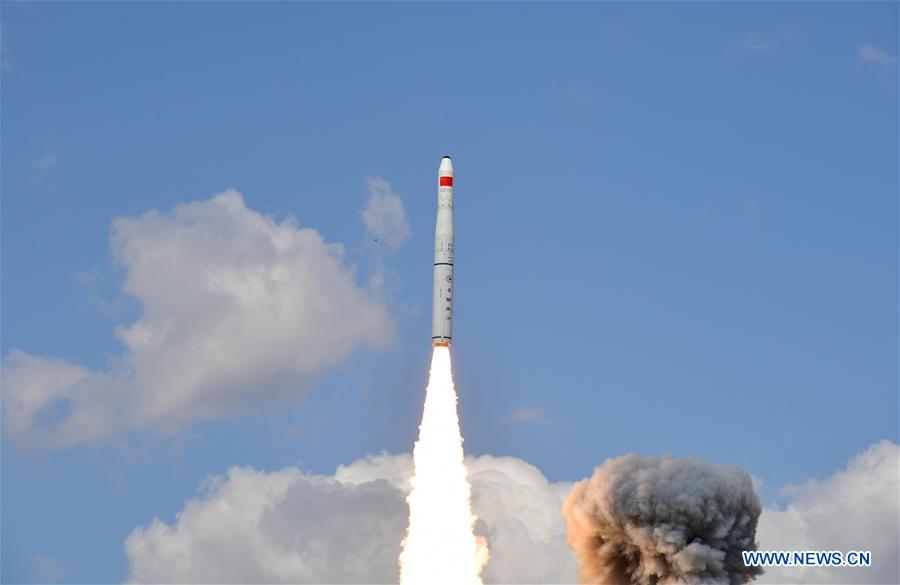
Five new remote-sensing satellites were sent into planned orbit from the Jiuquan Satellite Launch Center in northwest China's Gobi Desert Thursday.
The five satellites were launched by a Long March-11 carrier rocket at 2:42 p.m. (Beijing Time).
The satellites belong to a commercial remote-sensing satellite constellation project "Zhuhai-1," which will comprise 34 micro-nano satellites, including video, hyperspectral, and high-resolution optical satellites, as well as radar and infrared satellites.
The carrier rocket was developed by the China Academy of Launch Vehicle Technology, and the satellites were produced by the Harbin Institute of Technology and operated by the Zhuhai Orbita Aerospace Science and Technology Co. Ltd.
Thursday's launch was the 311th mission for the Long March series carrier rockets.
The newly launched satellites comprise four hyperspectral satellites with 256 wave-bands and a coverage width of 150 km, and a video satellite with a resolution of 90 centimeters.
The Zhuhai-1 hyperspectral satellites have the highest spatial resolution and the largest coverage width of their type in China.
The data will be used for precise quantitative analysis of vegetation, water and crops, and will provide services for building smart cities, said Orbita, the largest private operator of hyperspectral satellites in orbit.
The company aims to cooperate with government organizations and enterprises to expand the big data satellite services.
On June 15, 2017, the first two satellites of the Zhuhai-1 constellation were sent into space, making Orbita China's first private listed company to develop and operate a satellite constellation.
On April 26, 2018, four hyperspectral satellites and a video satellite of the Zhuhai-1 constellation were put into orbit.
The eight hyperspectral satellites already in orbit can cover the globe in 2.5 days, greatly improving the remote-sensing data collection capacity of the constellation, said the company.
The company is also developing a national satellite big data application platform to service sectors such as natural resources, ecological environment, emergency management and traffic management, said Yan Jun, chairman of Orbita.


