Ge Hong connects Tu Youyou with Nobel Prize
- By Lin Liyao
 0 Comment(s)
 Print
Print E-mail China.org.cn, October 14, 2015


Tu Youyou was announced as one of three scientists awarded this year's Nobel Prize in Medicine on October 5. The 85-year-old Chinese pharmacologist then became the first ever Chinese Nobel laureate for medicine.
|
|
| Chinese medicine classic titled "Manual of Clinical Practice and Emergency Remedies" written by Ge Hong. [Photo / jhnews.com.cn] |
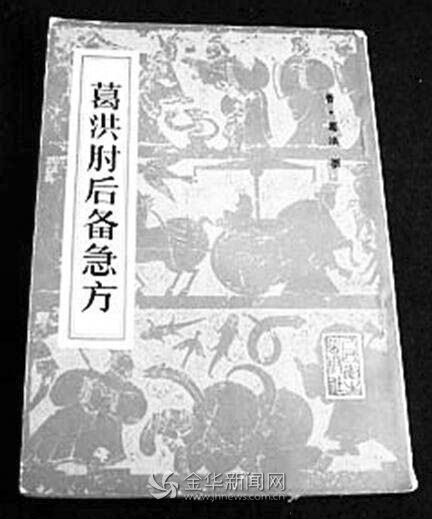
Tu is praised for her work in discovering artemisinin and developing effective drugs which have saved countless lives in the fight against malaria. Unlike other discoveries first made in a laboratory, Tu credited an ancient traditional Chinese medicine classic titled "Manual of Clinical Practice and Emergency Remedies" written by Ge Hong.
In Yiwu City, Zhejiang Province, there is a small village named after Ge. According to Chen Zhonghong, head of the village, the small place features Ge Mountain, Ge Peak, and Ge Creek.
Almost all the sites in the village are named after Ge, and every?farmer living there can tell you a range of stories about him.
So, who was Ge Hong?
|
|
| Ge Hong's portrait [image.baidu.com] |

The ancient Chinese pharmacologist lived during the East Jin Dynasty (AD 317- 340). In his ancient text, he mentioned sweet wormwood or, as it's pronounced in Chinese, qinghao being used to treat acute infectious disease such as dysentery.
Ge was also an expert on preventive medicine. In his most famous book, "Manual of Clinical Practice and Emergency Remedies," he recorded a strange epidemic disease, which made patients suffer a serious fever while experiencing white pustules on their skin. The disease was later discovered to be smallpox. Ge's record was 500 years earlier than the Arabic physician Muhammad ibn ZakariyāRāzī's.
Ge also mentioned scrub typhus in his text, finding that the disease at that time was prevalent in China's Fujian and Guangdong provinces, and was caused by an intracellular parasite orientia tsutsugamushi. His record was roughly 1,500 years earlier than the first English report made by Dr.Theobald Palm in 1878.
As a Taoism scholar, Ge was skilled in alchemy. During the process of refining mercury, he found the reversible reaction in a chemical reaction. He stated in another of his books titled,"Baopuzi" that heating mercuric sulfide produces mercury, while combining mercury with sulphur reverses the process.
In order to show their gratitude to the ancient pharmacologist, farmers in Ge Village still protect the places where it's believed Ge refined his alchemy, and worship Ge and his wife's statues in a Taoist temple on the Ge Peak.
"Ge Hong was a renowned pharmacologist and Taoist scholar during the East Jin Dynasty, who made great achievements in traditional Chinese medicine," the director of the villagers committee Feng Zeji said, "we will set up a tourist area in our village to encourage more Chinese people to better understand Ge's story and the splendid culture of traditional Chinese medicine."


