Lifts and heavy duty escalators to improve safety
 0 Comment(s)
 Print
Print E-mail
China Daily, August 16, 2011
E-mail
China Daily, August 16, 2011


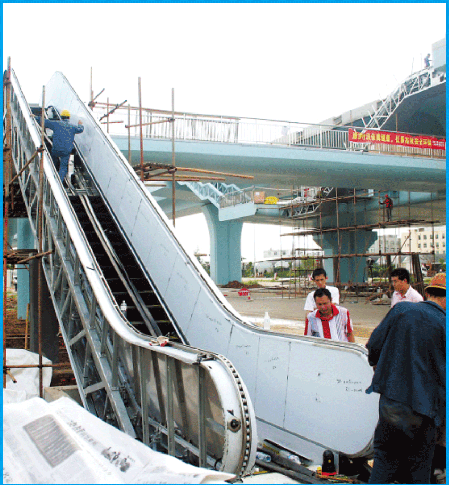
A new set of design rules calls for pedestrian bridges and underground passages in Beijing to be built with heavy-duty escalators that have brakes to prevent them from suddenly stopping or reversing direction.
 |
|
An escalator is installed in Chongqing. |
And more barrier-free accommodations should be made to ensure the disabled can use them, according to the Design Discipline for Barrier-free Equipment on Pedestrian Bridges and Underground Passages, which will take effect on Sept 1.
Experts say that only escalators that are considered "heavy duty" should be used in public transport facilities.
"Compared with escalators for commercial buildings, heavy-duty escalators for public transportation have larger track radii and other specifications, which help to make the equipment safer and longer lasting," said Zhang Lexiang, deputy secretary-general of the China Elevator Association.
The new design rules also stipulate that pedestrian bridges and underground passageways should have 1.5-square-meter platforms that can mechanically carry a person in a wheelchair up or down a flight of stairs. Wheelchair ramps should also be built to connect the stairs found in such places to the street.
Recent years have seen great progress in the construction of barrier-free access to shopping malls, railway and subway stations and other public places in Beijing, especially after the Beijing Olympic and Para Olympic games took place in 2008.
In 2010, China was home to about 83 million people with disabilities. That number is expected to exceed 100 million in less than five years.
Also in 2010, about 70 percent of urban residents with disabilities in China said they were satisfied with the barrier-free accommodations they found in cities, according to a report based on a national survey released by the China Disabled Persons' Federation.
Even so, it's still not easy for many residents in wheelchairs to get out and about.
"I could not reach the buttons inside the elevator in almost any hospital, shopping mall or residential building I visited," said Jiang Donghuan, who was paralyzed by rheumatoid arthritis 28 years ago.
"(The buttons) are too high for someone like me in a wheelchair," the 43-year-old Beijing native said.
Jiang said she hasn't been able to go to many tourist sites in the city because most of them are only accessible by stairs.
"It's a pity that I cannot visit those beautiful places, although I live here," she said.
Lu Jun, an anti-discrimination activist from the Beijing Yirenping Center, a non-government organization that promotes social justice, encouraged the municipal government to cut in half the ticket prices the disabled must pay to take public transportation.
"Many people with disabilities are either unemployed or living in poverty," Lu said.
"It's unreasonable to charge them the same prices as everyone else."


