Long arm of the law grabs its man


Hurdles to jump
Chen said three major legal issues hamper China's efforts to bring fugitives back to China for trial - the absence of extradition treaties, differences in social and legal systems, and the slow pace of integrating international conventions into domestic laws.
|
|
|
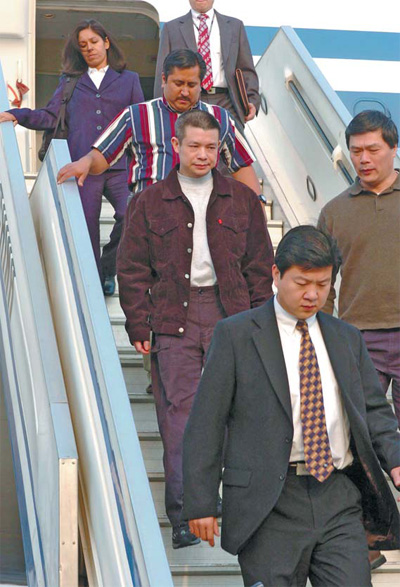
Yu Zhendong (middle) arrives in Beijing in 2004 on a repatriation flight from the United States. The former president of Bank of China's Kaiping branch, was accused of embezzling of 4 billion yuan. |
China has signed extradition treaties with 37 countries, but not Canada and the United States. Many Chinese criminal suspects have fled to those countries as well as to Australia and some Southeast Asian nations because of their different political, ideological and legal systems, he said.
As in Lai's case, fear of the death penalty is one claim that some suspects use in fighting repatriation. Fear of torture is another.
Meng Qingfeng, director of the Public Security Ministry's economic investigation bureau, had this comment: "China will comply with the relevant international conventions to protect the human rights and other legitimate interests of them in line with Chinese laws and regulations.
"Our judicial authorities will treat them in a just and reasonable manner in strict accordance with Chinese laws."
Chen also said that China and other countries signed UN conventions against corruption and against transnational organized crime at different times, so integrating the international conventions into their domestic laws is proceeding at different speeds.
China also has entered into 106 legal assistance agreements with 68 countries and regions, according to Ministry of Foreign Affairs. Results have been mixed.
"For some specific cases, although we have been making efforts to request legal assistance from some countries - considering the background of the case, the suspect's personal situation, political or economic impact - we haven't achieved any progress in getting the relevant fugitives back," Chen said.
The problem was echoed by the Canadian side. George Prouse, team leader of the Royal Canadian Mounted Police, told China Daily during an earlier interview, "Although I can't comment about some specific case... it can sometimes be a long and, at times, frustrating experience when you consider what is involved in the legal process. Especially for some special specific cases, delays are inevitable."
Sound mechanism
Experts say it is high time that the government reflect the reasons that official corruption continues, despite intensified anti-corruption efforts.
Hu Xingdou, an economics professor at Beijing Institute of Technology, said, "China's task of fighting corruption must be built on the establishment of a modern corruption-preventing system." Such a system, he said, would comprise disclosure by officials of their assets; the news media acting as watchdogs; and "the independent investigation of judicial departments."
Such a system, he said, would provide the transparency needed to discourage corruption by public officials.
Hu also said China needs to update its law on extradition. International circumstances and relations have changed dramatically since the law took effect in 2000, he said.
"Without the binding extradition contracts, the repatriation of a person from another country often lasts a long time in negotiation and involves high cost," said Sun Kui, a senior lawyer with Beijing Anheng Law Firm.
Chen, from the Anti-Corruption and Bribery Bureau, would like to see a more cooperative approach.
Countries of the world should rise above the differences in their political, economic and legal systems, he said. They should take a common principle and position, make joint efforts to create an environment against corruption, and allow no criminals to get away with impunity.


