China establishes national gene bank in Shenzhen
 0 Comment(s)
 Print
Print E-mail
Xinhua, June 18, 2011
E-mail
Xinhua, June 18, 2011


China established its first national gene bank on Friday in south China's city of Shenzhen with the support of the Beijing Genomics Institute (BGI), officials said.
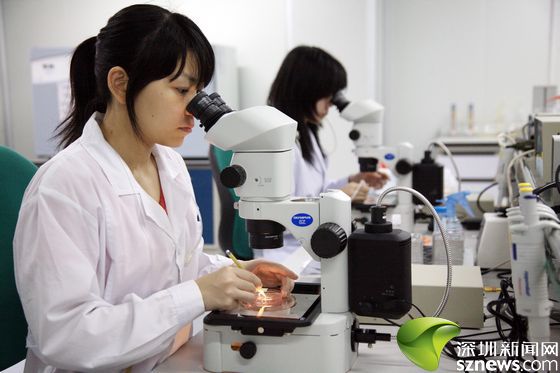 China established its first national gene bank in south China's city of Shenzhen on June 17, 2011 with the support of the Beijing Genomics Institute. |
With the establishment of the National Gene Bank in Shenzhen, China will be able to better protect, research and utilize its precious genetic resources, boosting the genetics industry and safeguarding the country's genetic information, said Qi Chengyuan, head of the high-tech industry department of the National Development and Reform Committee (NDRC).
The gene bank, which was approved by the NDRC in January, is based on data and facilities belonging to the BGI, but will grow with the help of extensive cooperation with other biological organizations both home and abroad, Qi said.
The national gene bank "aims to lead the development of international bioindustry as one of the world's largest gene banks," said Yang Huanming, the BGI's president.
The BGI, the world's largest genome-mapping institute, has more than 1,000 biological analysis devices working with top-of-the-line genome-sequencing machines.
Analysts say the BGI differs from conventional labs, as it can handle data in vast quantities and industrialize its research. Some believe lower wages in China have also contributed to the BGI's competitiveness.
Yang Bicheng, the BGI's spokesman, said the payment and welfare packages BGI offers are competitive in China's bioindustry.
"A researcher with about two years of experience earns around 100,000 yuan (15,440 U.S. dollars) a year. More outstanding researchers can get more, but the gap is not too great," Yang said.
Yang said greater motivation comes from better prospects for academic achievements.
"Our young researchers can work with the world's leading scientists, participate in global science projects and be pioneers in new fields of research. Only BGI offers these kinds of opportunities in China," Yang said.
The BGI has published 18 research papers in Science Magazine and the Nature Journal since 2007. The facility has become an international center for genome research and industrialization, with advanced technology and top talent, said Ji Xiaoming, head of the international cooperation department of the Ministry of Science and Technology.
China is working to make its genetic research industry into one of the country's pillar industries.
A plan approved by the State Council, or China's cabinet, in October 2010 said China will boost the industry by encouraging innovation, promoting industrial application of biological research, fostering market demand and deepening international cooperation.


