Authorities take steps to protect underwater heritage
 0
0 


 |
|
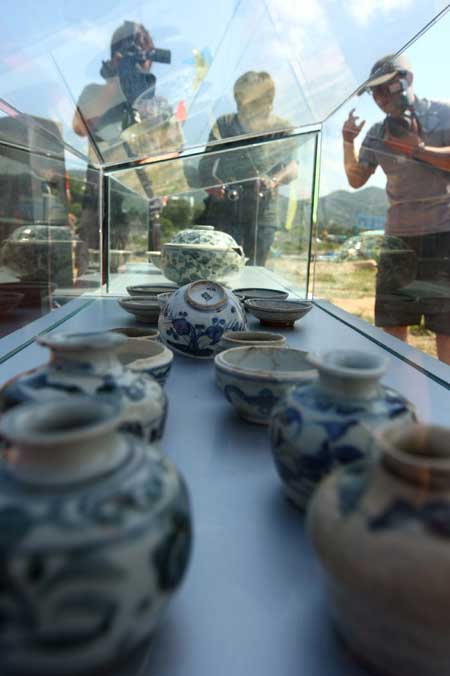
Archaeologists examine ancient porcelain wares that were excavated from the submarine cultural relic site of the Nan'ao-I in Shantou, Guangdong Province on September 26, 2009. |
China's cultural authorities are tightening safety supervision over the nation's vast number of marine heritage sites, but experts warn that a lack of professional staff and public awareness may slow down efforts to save underwater treasures.
The State Administration of Cultural Heritage (SACH) has announced a pilot program to monitor marine heritage sites in China's coastal provinces, and intend to recruit local authorities to provide long-term protection, China National Radio reported Tuesday.
|
Don't miss |
Non-stop radar scanning and ocean monitoring will be implemented by local marine police to prevent suspicious vessels from entering protected waters, the report said, without giving details of the locations of protected sites.
According to preliminary surveys, China has more than 200 marine heritage sites, some 70 of which are shipwrecks of great archaeological value.
Pu Gong, a Guangzhou-based researcher, admitted that the move has been prompted by the seriousness of illegal salvage. The pillaging of underwater sites has become so common that sometimes archaeologists discover a site long after robbers have already ransacked it, according to the report.
Undersea treasures
According to a China News Service report, China only began the study of marine archaeology in 1987, after cultural authorities were shamed by British "professional treasure hunter" Michael Hatcher, who in 1984 retrieved 150,000 pieces of Chinese porcelain, 125 gold ingots and two bronze guns from the remains of the Geldermalsen, a Dutch trading ship that sank in the South China Sea in 1752.
The porcelain reached US$20 million when auctioned at the Dutch branch of auction giant Christie's in 1985, which directly strengthened the Chinese cultural authorities' determination to protect their underwater heritage, the report said.
Despite improvements in its marine archaeological practices, China still has difficulties in putting together a clear picture of its underwater heritage, said the report.
A tough task for nationwide cultural relic authorities during the 12th Five-Year Plan (2011-15) is to figure out exactly how much underwater heritage China has, given the difficulty of marine operations, said the report.
Meanwhile, growing demand for Chinese artifacts in the international auction market and a lack of domestic regulation also pose challenges to authorities in protecting China's drowned heritage.


