Sun fires off with major solar flare
 0
0 


The most powerful solar flare in years erupted from the sun on Tuesday, sending a blast of X-rays from a hotspot of activity that may still belch solar storms in the days to come.
|
|
|
A strong sun flare erupts from a solar sunspot in a photo taken by the National Astronomical Observatories at 1:44 am (Greenwich Mean Time) on Tuesday. |
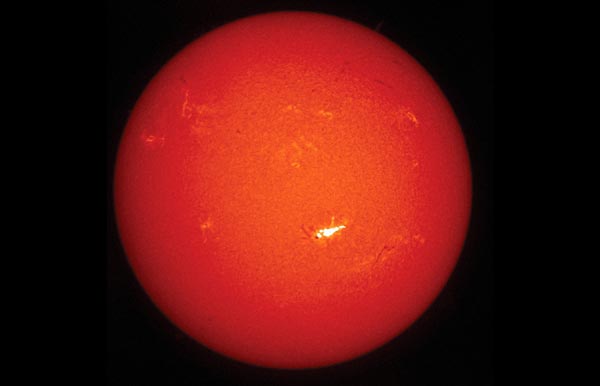
The sun unleashed the flare on Tuesday at about 1:44 am (Greenwich Mean Time) from a sunspot region that was barely visible last week. Since then the spot has grown to more than 100,000 kilometers across - nearly eight times the width of the Earth.
The United States' National Oceanic and Atmospheric Administration's (NOAA) Space Weather Prediction Center in Colorado categorized the flare as a class X2.2, the strongest solar flare observed so far in 2011.
"Astronomers have five categories of flares: A, B, C, M and X," explained Bao Xingming, solar physicist with the National Astronomical Observatories of the Chinese Academy of Sciences.
"The M and X flares are the most potent and the one that erupted (on Tuesday) was an X2.2, which is just about the most powerful flare we've seen in many years."
Solar flares appear to be caused by a sudden release of magnetic energy and emit light, ultraviolet waves and X-rays. There is often a disruption of radio communications shortly after major flares. Tuesday's eruption produced a loud blast of radio waves that was heard in shortwave receivers around the dayside of the Earth.
If at the time of the flare, the sunspot group is on the edge of the sun's disk, any electrified particles ejected by the flare would not reach the Earth, Bao said.
However, Tuesday's solar flare occurred near the middle of the sun's disk, meaning that the explosion of electrified particles could be "geo-effective", that is, directed toward the Earth, Bao said.
When those charged particles reach the Earth, they can create a geomagnetic storm that could influence the planet in several ways, including disrupting satellite communications and power grids. The particles also interact with the Earth's magnetosphere to create spectacular auroras known as the Northern and Southern Lights.
Ideally, the associated stream of particles would reach the Earth 37 hours after the eruption. But they can be quicker - 19 hours after the sun's epic fit measuring X10 in November 2003.
"We expect some impact from the eruption, such as communication disruptions, in the coming 24 hours," Bao said. "But there is no need to panic."
First of all, Bao explained, the eruption was very strong but not that big compared with the one in November 2003, when the NOAA Space Environment Center had to release warnings so that electrical utilities, airlines and spacecraft managers were able to take preventive action to minimize disruption of service - and the economy.
"This one shouldn't have much impact on the power grids," Bao said.
But Bao said Tuesday's eruption shows that the sun has entered an active period of its 11-year solar weather cycle after a lull in activity.
"More such eruptions, even more intense - either from the same solar hotspot or from others - are expected in the coming year or two," Bao said.
Tuesday's eruption is the second major Earth-directed flare from the solar hotspot. The first, on Sunday, ramped up Northern Lights displays on Monday, Bao added.


