Urbanization presents huge challenge for policymakers
 0
0 


China's urbanization rate, showing the number of people leaving the countryside to live in cities and towns, stood at 33.28 percent in 2008, an increase of 0.35 percentage points from 2007.
 |
|
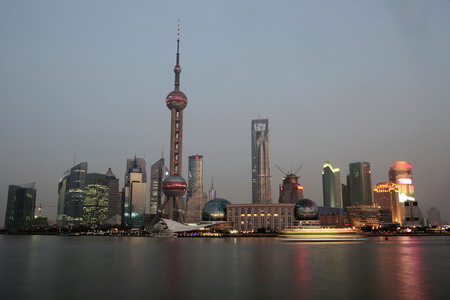
Buildings in the Pudong financial district in Shanghai. The ongoing urbanization process is regarded as a key driver for the country's rapid development in coming years. |
That's according to the latest findings of the China International Urbanization Development Strategy Research Committee (CIUDSRC).
However the figure, calculated on the proportion of non-agricultural workers in the population, shows a marked disparity with numbers published by a separate think tank.
The Chinese Academy of Social Sciences (CASS) said in its annual report on urban development that the country's urbanization rate hit 45.68 percent in 2008, based on the proportion of the urban populace within the overall population.
The CIUDSRC figure reflects the nature of what is called "semi-urbanization". That is, the number of workers who are still technically registered as being resident in villages, but who are actually living and working in cities.
The differing methods of calculation have resulted in a 12.4 percent gap between the figures.
However, the CIUDSRC figures suggest that 161 million people have left rural areas but don't enjoy the same benefits as their urban peers in terms of income, children's education, social security and voting rights, said Zhang Qingfeng, deputy director of CIUDSRC.
"Such a huge group, which we refer to as 'a gray population' or 'semi-urbanized' will pose a big challenge for China," said Zhang.
He said most provinces and autonomous regions, with the exception of the Xinjiang Uygur autonomous region, are experiencing a process of "semi-urbanization".
The ongoing urbanization process is regarded as a key driver for the country's rapid development in coming years.
According to CASS, the acceleration in the number of workers moving to cities and towns will keep the economy on a fast track for another 15 to 20 years, as more than 50 percent of the population will live in urban areas by 2015.
The urbanization rate during the country's 12th Five-Year Plan (2011-2015) will grow by between 0.8 and 1.0 percent each year, the academy reported.
That means more than 10 million rural residents will move to cities and towns annually. That process is expected to contribute 4 percentage points to GDP growth each year.
Of those 4 percentage points, 3.6 will be the result of increased housing construction worth 1.2 trillion yuan ($177 billion). The remaining 0.4 percentage points are expected to come from the improved incomes, valued at 120 billion yuan.
By the end of 2009, the urbanization rate had already hit 46.6 percent, with 620 million people living in cities and towns, according to CASS.


