A right bloody mess
 0
0 


Zeng has no relatives in Beijing.
That was how Zeng first heard about blood touts who can arrange for donors.
 |
|
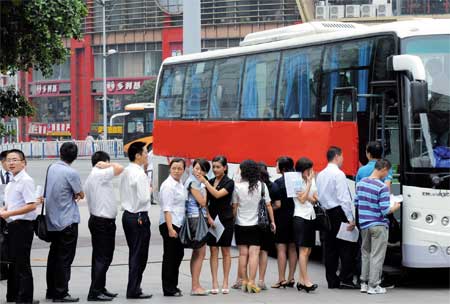
Chongqing residents donate blood on the street on August 31. |
"They said they can find people to donate blood, but it costs a lot," Zeng said.
Until two months ago, 400 milliliters of blood cost about 1,500 yuan, according to Beijing Times, but the price of back street blood hit 3,000 yuan last month.
The touts pay college students and migrant workers 300-500 yuan for their 400 milliliters.
It's nothing new, said the blood center director Liu Jiang. Fake friends have long been arriving at the center waving a stranger's application form to donate blood a day or two ahead of surgery.
An anonymous Beijing Health Bureau official pledged to crack down on blood agents, telling the Beijing Times it was "illegal."
Blood shortages come along almost every year, Director Liu said, but this one is serious: In Beijing, blood stocks were 1.6 million milliliters in the first week of November, while the norm is 2.4 million milliliters.
"A sudden drop in temperature directly caused a decline in donors," Liu said.
Also improving health services require increasing amounts of surgery, Liu explained, meaning demand for blood has expanded 10-15 percent annually over recent years.
Philanthropy shortage
More significantly, whereas 454 out of every 10,000 people donate blood in developed countries, on the mainland it is a pitiful 84 out of every 10,000 Chinese.
"College students and migrant workers are the main source of donated blood, accounting for 60 percent of all donors, while only 40 percent was provided by local residents," Liu said.
Government officials were 1.9 percent of all donors at blood centers in Kunming. As the capital of Yunnan Province suffers its most serious, headline-grabbing, blood shortage in a decade, medical employees formed 1.2 percent of all donors.
"Since they [civil servants and medical staff] promote blood donations as harmless, why don't they set an example by personally taking part?" said Wang Qing, a Beijing white-collar worker. "Otherwise, how will we be persuaded by such campaigns?"
Health Minister Chen Zhu rolled up his sleeve and donated blood in Beijing on October 30 after the Chinese Red Cross Society made an urgent appeal for donations. A day later, more than 300 college teachers and students from more than 20 universities in Beijing registered to donate blood.
"As our country has suffered several catastrophes this year, I felt obliged to donate blood," Wang Xiaohu, a junior at Communication University of China, told the Beijing Youth Daily.
Wang and his classmates who donated blood enjoyed welfare benefits and preferential policies like better chances of obtaining a university scholarship. University students who donate blood in Tai'an, a prefecture-level city of Shandong Province, receive an employment recommendation letter.


