The national province-level re-election fully ended this January. Among 815 leaders of the new provincial leaders, 106 are female, accounting for 13 percent. Six of them hold the major position, namely Song Xiuyan from Qinghai, Jin Yinhuan from Shanxi, Zhang Lianzhen from Jiangsu, Liang Qiping from Fujian, Song Yuying from Hubei and Xing Yuanmin from Chongqing. Excepting Song, the other five are all chairwomen of the provincial committees of the Chinese People's Political Consultative Conference (CPPCC).
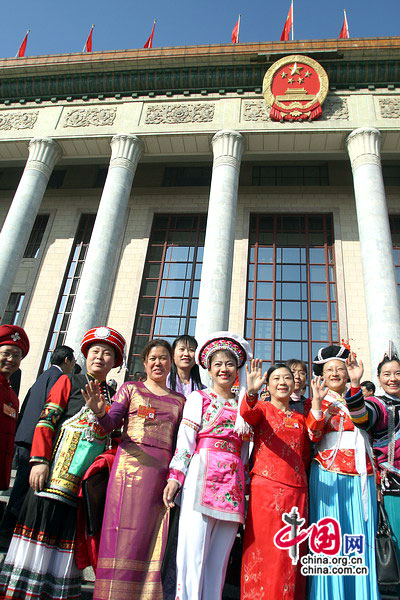
The data shows in the previous term that only 40 to 50 females existed in the province-level leaders, with two as chairpersons of local CPPCC committees. When the general number of province-level cadres reduced, females hugely increased. This caught the public's attention.
At the on-going annual session of the National People's Congress (NPC) and the CPPCC National Committee which began on March 2, more new female state leaders are expected. Previously, the number was nine.
With more female high-position leaders showing themselves, clearly today's females are participating in the national governmental and management affairs more profoundly and widely. Professor Li Min from the Party School of the CPC Central Committee thought this strongly evidenced the upgrade in women's social status and an overall improvement in Chinese society.
Karl Marx said the degree of women liberation weighs the advancement of the human society. As a Marxist party, the Communist Party of China emphasized on improving women's political status from the very beginning.
In China's first central governmental institutes, there is one state vice chairwoman (Soong Ching-ling), three female ministers (Minister of Justice Shi Liang, Minister of Health Li Dequan and Chairwoman of the Overseas Chinese Affairs Committee He Xiangning), and 20 female cadres at vice minister level.
Since the 1980s, women's participation in politics reached a higher level. One significant change is institutionalization. In April of 2001, an opinion on better training and selecting female cadres and developing female Party members by the Central Organization Department was issued and was considered as the China's active system criterion. As a matter of fact, during elections at all levels, there's mandate index for the quota of women. Although this is disputed, it undoubtedly and actively pushed women entrances into politics.
Actually, the legislative safeguard of women's participation in politics reflects the same experience all over the world. In 2004, 14 countries and regions regulated the females' proportion in the state congress in their constitutions. In China, the Election Law of the People's Republic of China on the National People's Congress and Local People's Congresses regulates that "there should be a certain number of women delegates and to gradually improve their proportion". Relative regulations also exist in the Law on Protection of Women's Rights and Interests.
According to the statistics in 2007, China had more than 15 million women cadres, making up 40 percent of all cadres.