
 0 Comment(s)
 Print
Print E-mail China.org.cn, April 8, 2025


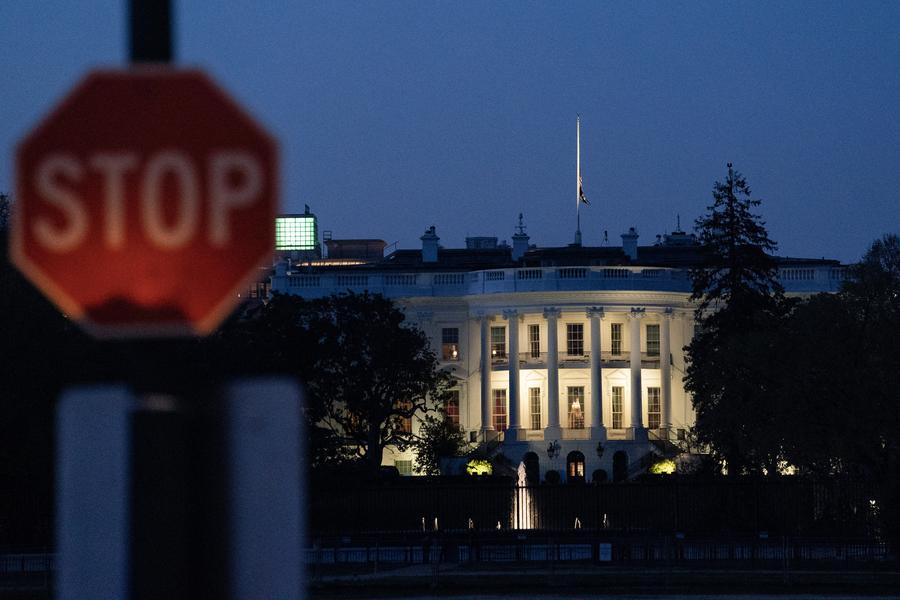
This photo taken on March 29, 2023 shows the White House in Washington, D.C., the United States. [Photo/Xinhua]
China's recent trade countermeasures against U.S. tariff hikes are a reasonable and legitimate act of self-defense, Liu Yingkui, a researcher at the Academy of China Council for the Promotion of International Trade, told China.org.cn in an exclusive interview. Liu said that these tariffs, unprecedented in scale and reach since World War II, could disrupt global supply chains and potentially backfire, unleashing global economic turmoil.
The remarks came after the U.S. announcement of country-to-country "reciprocal tariffs," including a 34% levy on China that escalated U.S. tariffs on Chinese goods to 54%. In response, China filed a lawsuit with the WTO and announced an additional 34% tariff on all U.S. imports.
Just days after the U.S. announcement, global market tumbled as tariff-fueled financial chaos stoked recession fears: trillions of dollars were wiped off the U.S. stock market, plunging the once soaring NASDAQ 100 into bear territory, and Asia-Pacific markets traded sharply lower on Monday.
"China is countering America's erratic trade policies with predictability," said Liu. "China will not tolerate U.S. bullying or allow the U.S. to dictate terms. Instead, it will act decisively to protect its legitimate interests — not to heighten tensions, but to push the U.S. back to the negotiating table."
Liu argued that the U.S. concept of "reciprocity" lacks a scientific basis, and its unilateral and arbitrary imposition of blanket tariffs blatantly violates the World Trade Organization's (WTO) principles of free trade and fair competition.
In a post clarifying how the tariff rates were calculated, the U.S. Trade Representative used a formula with parameter values that deviate from mainstream norms. Essentially, it boils down to dividing the U.S. trade deficit with a country by that country's exports to the U.S. The method has sparked widespread skepticism online, including a viral tweet with over 19 million views questioning its over-simplicity and credibility.
"The U.S. is trampling on decades of postwar tariff concessions achieved through global cooperation — including its own contributions — and shirking the international responsibilities of developed nations by imposing steep tariffs on most developing countries," Liu said.
He warned that the U.S. tariffs, intended to boost U.S. revenue, re-shore manufacturing, and reshape supply chains, could ultimately backfire. The projected fallouts include spiking consumer prices, higher costs disrupting U.S. industries, and retaliatory actions against U.S. exports, potentially worsening economic strain rather than alleviating it.
For instance, Canada responded swiftly, announcing retaliatory tariffs on certain vehicles imported from the U.S.
"The expected tariff revenue gains would hardly compensate for the fiscal losses caused by an economic downturn. Far from alleviating America's fiscal woes, these policies may actually compound the financial burden," Liu said.
"While the U.S. abandons WTO principles and wages arbitrary trade wars, China, as the world's largest trading nation in goods, remains committed to openness and cooperation," Liu said, adding that through the Belt and Road Initiative and broader market access, China continues to champion extensive consultation, joint contribution, and shared benefits to bolster global stability.
"The Chinese economy is highly resilient to pressure, thanks to its robust industrial system, cost advantages, and global competitiveness, and growing reliance on domestic spending and diversified export markets further insulate it," Liu said.
According to data from China's General Administration of Customs, between 2018 and 2024, U.S.-bound exports dropped from 19.2% to 14.7% of China's total, while exports to ASEAN rose from 12.8% to 16.4% and to Belt and Road partner countries from 38.7% to 47.8%. According to data from China's National Statistics Bureau, final consumption drove 44.5% of China's GDP growth last year, outpacing investment and exports, and lifting GDP by 2.2 percentage points.
Liu also framed China's resilience through a cultural lens: "The national spirit of self-reliance, resilience, and unity only grows stronger under pressure." The spirit translated to market action Tuesday, as Chinese listed firms accelerated buybacks and major shareholders increased stakes, while voicing confidence in the long-term outlook of the country's capital markets.
A Chinese government statement on Saturday reinforced this stance: "We don't provoke trouble, but we don't fear it." It stressed that pressure and threats are not the right way to engage with China, and that China has taken and will continue to take resolute measures to safeguard its sovereignty, security, and development interests.


