Crucial debt audit helps gov't tackle borrowing
- By Yan Pei
 0 Comment(s)
 Print
Print E-mail China.org.cn, August 28, 2013


|
|
|
A yawning gulf. [China.org.cn] |
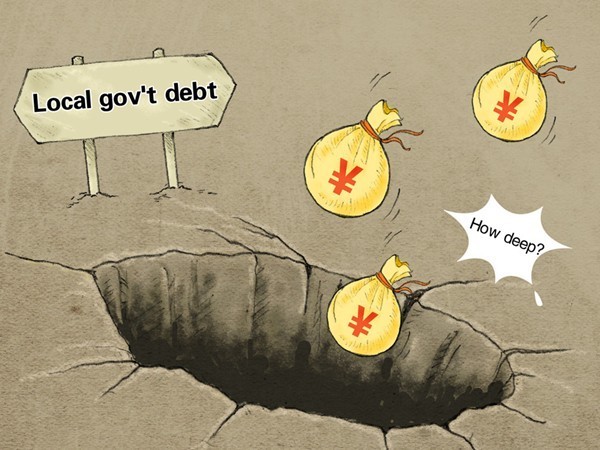
China's National Audit Office (NAO) on July 28 issued a brief statement confirming that it would carry out an audit of total government debt at the request of the State Council, China's cabinet. The audit reflects the new administration's concerns about surging borrowing levels among the country's local governments.
China has faced the threat posed by growing debt levels since local governments started borrowing heavily to sustain economic growth at the beginning of the global financial crisis in 2008. The borrowed funds were principally invested in infrastructure projects, which yielded very low returns. The result is that concerns have risen over the ability of local governments to repay debts, as such debts would expose China's economy to both systematic and macroeconomic risks.
China's ongoing national audit is seen as the crucial first step towards handling the debt issue.
Getting the true picture
According to a report in the Economic Observer, the ongoing audit will cover five levels of government: central, provincial, municipal, county and township. Previous audits only covered provincial, city and county-level governments.
The audit will be able to uncover the scale of borrowing at all levels of government, an official from the National Development and Reform Commission was quoted as saying.
"The most important task at this stage is to find out the real situation (about government debt)," said an official close to the NAO.
China has carried out two previous audits into government debt, with the first audit, conducted in 2011, finding that China's local government debt stood at 10.7 trillion yuan (US$1.73 trillion) by the end of 2010.
In June this year, after a random audit, the NAO found that 36 local governments owed a total of 3.85 trillion yuan by the end of 2012. The debt was 12.94 percent higher from two years earlier, said the NAO.
Addressing the problem
The current audit is seen as one of the most crucial tasks facing the new administration, as there is currently no clear picture of China's debt situation.
Vice Finance Minister Zhu Guangyao admitted in June that the central government did not know precisely how much debt local governments had built up.
Speaking at a press conference ahead of the fifth round of the China-U.S. Strategic and Economic Dialogue, Zhu said that China's financial sector is facing great challenges, including underground lending and local government debt.
Despite this, the new administration has come to grips with the debt problem since taking office in March.
On April 17, Premier Li Keqiang cautioned against local government debt and massive bank lending at a State Council executive meeting.
At another State Council meeting presided by Premier Li on May 6, the government vowed to investigate the extent of local government debt and improve openness and transparency over local government budgets.
Liu Jiayi, auditor general of the NAO, warned on June 28 that the risks posed by government debt may threaten China's economic development, and called for local governments to improve their management of finances and state-owned assets.
On July 28, ten days after the U.S. city of Detroit filed for bankruptcy, the State Council ordered the NAO to launch a nationwide debt audit.


