Popular Cannes film reflects 'Arab Spring' spirit
 0
0 


 |
|
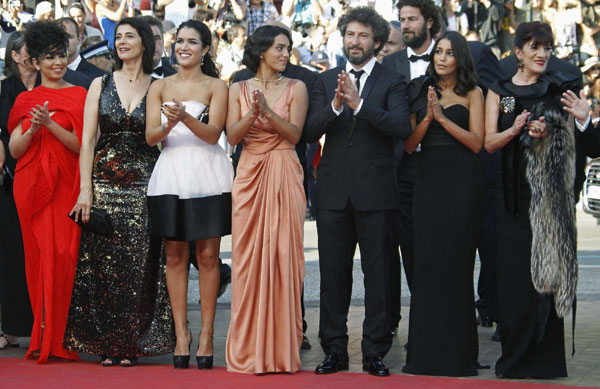
Director Radu Mihaileanu (3rd R) and cast members (L - R) Hiam Abbas, Sabrina Ouazani, Hafsia Herzi, Leila Bekhti and Biyouna pose during red carpet arrivals for the film "La Source des Femmes", in competition at the 64th Cannes Film Festival, May 21, 2011.[Photo/Agencies]? |
A film about a woman taking a stand against men in a North African village won cheers in Cannes Saturday, with some viewers moved by its expression of the spirit of the "Arab Spring" uprisings.
A small handful of critics also booed during the packed screening of "The Source," directed by Radu Mihaileanu, later telling journalists they found its depiction of Arab life over simplistic.
But the overwhelming majority of critics in the audience praised its resonance with real-life events, saying they would not be surprised to see it scoop a big prize at the annual film festival.
The Source was the last of 20 films shown in the festival's main competition ahead of the closing ceremony Sunday where the awards will be announced including the Palme d'Or for best picture.
Also premiered Saturday was "Once Upon a Time in Anatolia," a slow-paced, subtle examination of cruelty and betrayal by Nuri Bilge Ceylan.
The Source opens by declaring itself a fairytale in which Leila, the beautiful and feisty wife of teacher Sami, declares a "love strike," or ban on all sex, until the men in her village agree to carry the water from a spring high in the mountains.
In a time of economic hardship and unemployment, men sit and sip tea all day while women lug heavy loads up steep paths.
Leila decides to take a stand when her friend falls and loses her baby.
Men and women fall out, with violent consequences. Women bicker about the value of tradition over change while conservative clerics try to exploit the village's divisions.
"NEED FOR MORE REVOLUTIONS"
Mihaileanu, a Romanian-born French director, told a news conference in Cannes that the film was partly a reflection of the recent uprisings in Tunisia and across the Arab world.
"There has been tremendous hope since last December. There is hope for freedom and a strong desire to get rid of those in power and there is the idea of people deciding their own destiny," he said.
He added that revolution on the streets of Egypt, Tunisia, Syria and Bahrain had yet to be matched by a change in people's homes.
"There is a second revolution which is essential, which is the revolution in the home, and the place of women in the family. Women should be made equals at home as well."
The director, who is Jewish, said the idea for the film came from a true story in Turkey.
Leila leads the battle in the village, confronting the village imam and quoting from the Koran in defense of her case.
She is defended by one of the film's most colorful characters -- Mother Rifle, whose words are "like bullets," played by Algerian actress Biyouna.
Turkish entry One Upon a Time in Anatolia follows a group of police officers and a doctor as they look for the corpse of a murder victim buried in the countryside.
Light on plot, it has nonetheless won over critics with its craftsmanship.


