Music of the Zhou Dynasty delights Beijing audiences
 0 Comments


 |
|
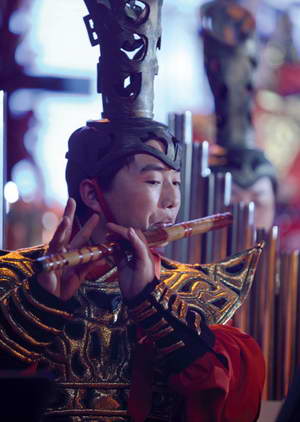
A Chou Rituals Orchestra musician playing the flute. [Global Times] |
A type of folk music which Chinese emperors and court dignitaries enjoyed nearly 3,000 years ago returned to Beijing last week. Performed by the newly-formed Chou Rituals Orchestra, Zhou Dynasty (1100-256BC) music was a rare treat for audiences at the Great Hall of the People.
Zhou music can be traced back to Baoji, Shaanxi Province, the birthplace of many traditions from the Zhou and Qin (221-206BC) dynasties. Rites and music systems established during the Western Zhou Dynasty (1100-771BC) had a far-reaching effect on many societies and cultures that followed.
The Chou Rituals Orchestra comprises of mostly traditional Chinese folk and percussion instruments, including bells, stone chimes, gongs, the guqin and ruan.
In China's ancient matriarchal societies, most people subsisted on fish and hunting and would knock together stones to signal the end of a day's work. The stones were later turned into a percussion instrument in the form of chimes.
Most of the folk music played by the Chou Rituals Orchestra is based on ancient Chinese stories, legends and even fairytales, which audiences are able to get a better understanding of from text displayed on a big screen during the performance.
The Beijing concert's second song, "Giving Position to the Wise," is about a Zhou Dynasty emperor Gu Gong and his three sons, Tai Bo, Yu Zhong and Ji Li. Bo and Zhong are before Ji in the line of succession but both can tell that their father has a preference for Ji's son Ji Chang.
"Giving Position to the Wise" employs a double fugue imitation singing style to express Bo and Zhong's narrative. The two brothers repeatedly discuss succession as their rising and falling moods finally conquer their sensibilities. In the end, Bo and Zhong flee to the country at night and live as common folk for the rest of their lives. The music fading toward the end reveals Bo and Zhong's grief as they tear themselves away from their home.
The Chou Rituals Orchestra has only been performing for a short time and is aimed re-popularizing the ancient music form.
"Most members of the orchestra have just graduated from university. We need them because we want to develop and enhance young people's passion for classical music," Shangguan Jiqing, Baoji's deputy mayor, told the Global Times.
The group of young musician has already received several invitations to play overseas and in December will perform in Singapore followed by the Netherlands in February.
"China has founded more than 200 Confucius Institutes worldwide; Confucianism originated during the Zhou Dynasty. The road for the Chou Rituals Orchestra to take their music to the world is clear," Shangguan added.


