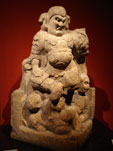
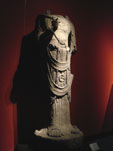
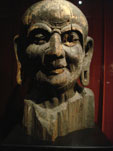
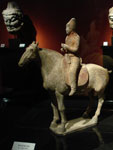
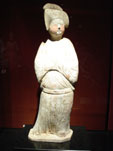
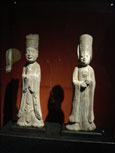
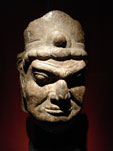
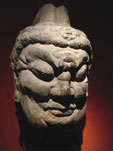
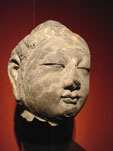
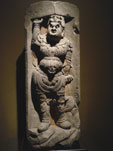
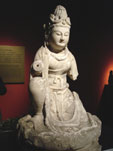
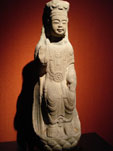
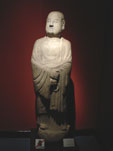
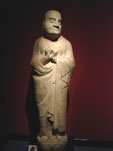
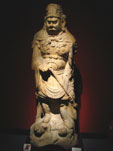
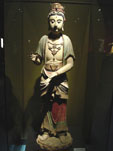
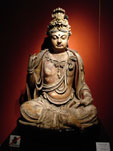
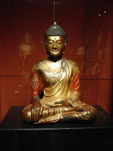
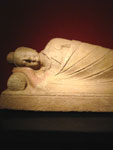
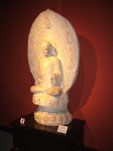
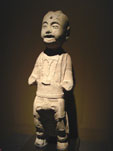
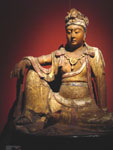
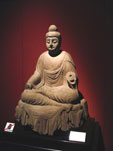
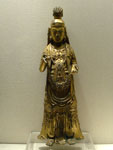
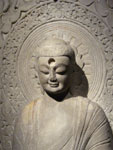
Nestled on People’s Square in the center of Shanghai, Shanghai Museum stands tribute to those ancient Chinese artifacts that bear witness to the country’s ancient wisdom and philosophy. Among eleven such exhibits, the Gallery of Ancient Chinese Sculpture is held in high regard.
(All Photos by Wang Zhiyong)
The Gallery of Chinese Ancient Sculptures serves mainly as a showcase of over 120 Buddhist sculptures, placed in shrine-like displays and framed with lotus-petal shaped partitions, or standing alone on pedestals. These display methods blend to lend a veritable temple feeling to the hall and plunge the audience into a world where art and religion intertwine.
The exhibits, ranging from the Warring States period (475-221 BC) to the Ming dynasty (AD 1368-1644), track the evolution of Chinese sculpture across these varying periods. Different styles of Buddha statues can be seen, with focuses ranging from delicate and simple works while others carry more elegant lines or full-bodied subjects. Visitors are thus able to appreciate the transition undergone by Buddhism as it was absorbed into traditional Chinese culture.
Buddhism first came to China from India and Central Asia in the first century A.D. In the early Northern Wei period (AD 386-534), Buddhist sculptures were influenced by artistic trends coming from Gandhara (northwest Pakistan and Afghanistan), namely being decked out in long flowing robes and girdles. In the Western Wei period, the statues shifted to emphasize strong bodies, round faces and intricately-woven robes. Later on, in the Northern Qi dynasty (550-577), the statues became more sophisticated with slim and graceful appearances, whilst clothed in delicate garments and attention paid to linear details. These statues also took on a thoughtful air which became a mainstream sculpture facet until the Sui dynasty (581-681).
The Tang dynasty (618-907) stands out as a jewel in terms of Chinese artistic accomplishment, ushering in a passion for realism. Figures made at the time leant towards well-proportioned appearances, their increasingly perfect aspect depicting the capacity of reaching out to all living creatures.
During the Song dynasty (960-1279), the beauty of the human body became de rigueur but this tailed off during the Southern Song period when advancements in sculpture were few. Its followers in the Yuan and Ming dynasties (1271-1644) continued the downwards trend, becoming mired in routine and lacking creativity.
Travel tips:
Admission Fee: 20 yuan
Opening Hours: 9:00 to 17:00 daily, last entry at 16:00
Recommended Time for Visit: 3 hours
Address: No.201 Renmin Avenue, Shanghai
How to get there: Bus routes 46, 71, 112, 123, 145, 574 and 934 or Subway No. 1
(China.org.cn by Wang Zhiyong May 18, 2007)