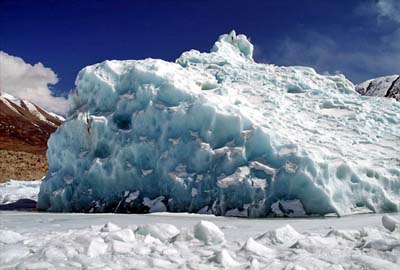
The Tibetan and Xinjiang glaciers -- the major source of Asia's biggest rivers -- have melted by up to an alarming 17 percent at certain spots in the past four decades.
In interviews with China Daily, Chinese scientists have revealed that the world's highest glaciers are melting at a much faster rate than previously believed.
The meltdown, caused by global warming, is seriously threatening the survival of major rivers, including the Yangtze, the Mekong, the Yellow River, the Indus and the Ganges, which originate from these glaciers.
The findings were made in an ongoing study of the Chinese Academy of Sciences (CAS), which began in early 2000s and covered more than 20,000 sq km, or about 40 percent of the glaciers in the country.
About 4.2 percent of the glaciers have disappeared since the previous survey was carried out between 1956 and 1980, said Liu Shiyin, a researcher at the CAS' renowned Cold and Arid Regions Environment and Engineering Research Institute in Lanzhou, capital of Gansu Province.
"The shrinking of glaciers has picked up speed in the past decades," he said. "While there might be more water in the rivers at present because of the increased melting, in the long run, the glacier water will decrease, and droughts will follow."
The most drastic melting was at the origin of the Yellow River in the Mount Anemaqen on the Qinghai-Tibet Plateau. About 17 percent of the glaciers have gone in the past four decades and their shrinkage will have major impact on the Yellow River, the "mother river of China", which feeds 130 million people in its reaches, or one-10th of the population.
Glaciers have shrunk by 9 percent at the Qomolangma and its surrounding areas in the central-north part of the Himalayas, and by 8 percent in the western part of the massive mountain system, which feeds the Yangtze, the Mekong, the Indus and the Ganges.
People living in the Gansu Corridor (or Hexi Corridor), a chain of oases linking China's central plains with its western frontier of Xinjiang, have been hit most by the meltdown's consequences, especially desert expansion.
Glaciers in the Qilian Mountains have for centuries been the most important water source in the area which has little rainfall, and they have been reduced by 8 percent in the past decades.
(China Daily July 24, 2007)