Police officers should be stationed in hospitals across the
country to help keep the peace and avert the need for medical staff
to wear protective clothing while they are trying to save lives, a
spokesman for the Ministry of Health (MOH) said yesterday.
"Bringing about a harmonious medical service environment is not
just down to the hospitals," MOH spokesman Mao Qun'an said when
asked to comment on a nationwide rise in the number of medical
disputes, which occasionally turn violent.
"The police should be more involved in safeguarding hospital
staff and the facility itself," he said, calling for a joint effort
to halt the violent trend and provide a better service for
patients. According to MOH figures, in 2006, 9,831 attacks stemming
from medical disputes caused more than 200 million yuan (about
US$26 million) worth of damage to hospital property.
In the same year, more than 5,500 medical personnel were injured
in attacks by patients or their relatives as a result of
disputes.
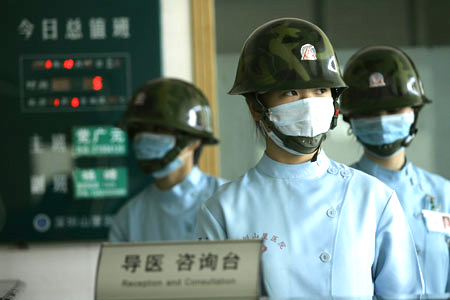
The situation reached a critical level at the end of last year,
when employees at a Guangdong hospital were forced to wear safety
helmets to protect themselves from attack by a group of people who
felt they had been wrongly treated.
During the incident, the mob smashed medical equipment, burned
papers and candles (a traditional Chinese way to remember the
dead), and left a dead body in a public area of the hospital for
several days, the Xinhua News Agency reported at the time.
"Such extreme events, which damage patient-doctor relationships
and disrupt the day-to-day running of hospitals, could be prevented
if all concerned parties, including the police, worked together,"
Mao said.
Partly in response to cries from hospital staff for more
protection, Wuyishan in the eastern part of east China's Fujian Province, last month stationed police
officers in 14 of its hospitals.
They were charged primarily with resolving medical disputes and
handling unrest, a Xinhua story said, as well as maintaining order
and preventing theft.
Inspired by Wuyishan's lead, several other hospitals across the
country have since followed suit.
Vice-minister of Health Chen Xiaohong recently ordered all
medical institutions to map out emergency plans for dealing with
medical disputes.
(China Daily May 11, 2007)